- LET'S PLAN YOUR SAFARI
- +256 200 921 002
- +256 793 194 703
- info@pickandtransfersafaris.com

2 Days Gorilla Trek and Batwa Experience
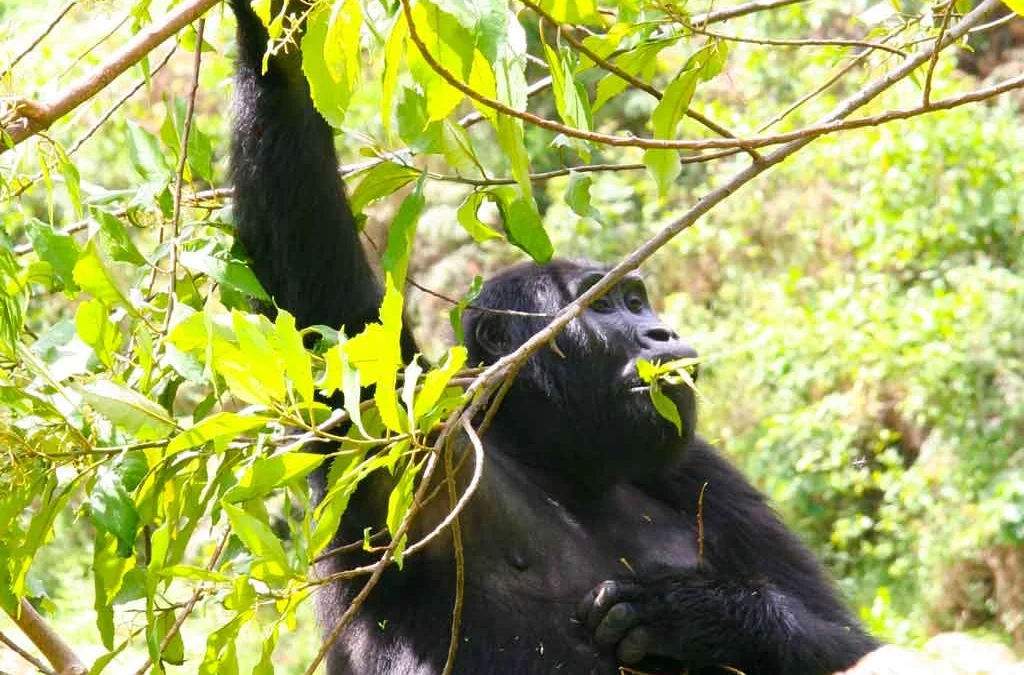
2 Days Gorilla Trek and Batwa Experience. There are two encounters in southwestern Uganda that travel writers consistently struggle to describe adequately — not because the words are insufficient, but because both experiences operate at a depth that prose alone cannot quite contain. The first is spending an hour with a wild mountain gorilla family in Bwindi Impenetrable Forest National Park. The second is meeting the Batwa people — the original forest-dwellers of Bwindi, whose ancestors lived alongside those same gorillas for thousands of years before they were displaced from their ancestral home by the creation of the national park. Together, over two days starting from Kigali, these two encounters form one of the most complete, most moving, and most culturally rich short safari experiences available anywhere in East Africa.
At Pick and Transfer Safaris, combining gorilla trekking with the Batwa cultural experience is something we arrange for travelers who want to leave southwestern Uganda understanding not just the wildlife of this extraordinary region but the human story inseparable from it. Our 2 Days Uganda Gorilla Tour Starting from Kigali can be tailored to include the Batwa experience as part of the second day, creating a two-day itinerary that is as culturally rich as it is wildlife-extraordinary. For planning and permit availability, email our team at info@pickandtransfersafaris.com and we will respond promptly.
Who Are the Batwa?
The Batwa — also known as the Twa, and often referred to as the Keepers of the Forest — are one of the oldest indigenous communities in Central Africa, a pygmy people who lived in the forests of southwestern Uganda for thousands of years before the colonial era and the creation of Uganda’s national parks. For generations, they lived as skilled hunter-gatherers in the dense rainforests of what is now Bwindi Impenetrable Forest National Park and Mgahinga Gorilla National Park, drawing their food, medicine, shelter, and spiritual life from the forest in a relationship of profound depth and intimacy. They knew every plant and its medicinal properties. They understood the behavior of the animals around them — including the gorillas — with a closeness born of centuries of coexistence. Their knowledge of the forest ran deeper than any scientific survey has yet been able to fully document.
In 1991 and 1992, when Bwindi and Mgahinga were formally gazetted as national parks in the interest of wildlife conservation — specifically, the protection of the critically endangered mountain gorilla — the Batwa were evicted from the forests without compensation and without legal recognition of their ancestral claim to the land. Forced to settle on the edges of the parks they had always called home, they became squatters in their own territory, stripped of the forest that had sustained their entire way of life. Today, approximately 3,000 Batwa people live in Uganda, primarily concentrated in the Kigezi region of the southwest, and they remain among the most marginalized communities in the country.
The Batwa cultural experience that visitors to Bwindi can participate in today is a direct response to that history — a community-led initiative developed in partnership with organizations including the United Organisation for Batwa Development in Uganda (UOBDU), the Uganda Wildlife Authority, and international development partners, designed to give the Batwa an economic stake in the tourism that has transformed their ancestral forests while providing visitors with an encounter that is as educationally significant as it is personally moving.
Day One: Kigali to Bwindi
Your driver-guide from Pick and Transfer Safaris collects you from your Kigali hotel between 6:30 and 7:00 AM. The drive northwest through Rwanda — through the famous thousand hills, past the Virunga volcanoes on the horizon, and across the Cyanika border into Uganda — takes four to five hours and is beautiful throughout. From the border, the route continues through the terraced hills of Kisoro district and the Kigezi highlands toward your accommodation near Bwindi’s southern sectors.
You arrive in the early to mid-afternoon. The rest of day one belongs to settling into the extraordinary forest atmosphere of southwestern Uganda — walking the lodge grounds, watching the light change on the Bwindi canopy, enjoying an early dinner, and resting well before the two main experiences of day two. Many nationalities qualify for the East Africa Tourist Visa covering Rwanda, Uganda, and Kenya — full details on the Uganda Directorate of Citizenship and Immigration Control website.
Day Two, Morning: The Gorilla Trek
The day begins with an early breakfast before the short drive to your sector’s park headquarters. Rangers from the Uganda Wildlife Authority lead the morning briefing — covering gorilla behavior, trekking etiquette, safety protocols, and the specific gorilla family you have been assigned for the day. The Uganda Wildlife Authority limits trekking groups to a maximum of eight visitors per gorilla family per day, a restriction that ensures every encounter is intimate, carefully managed, and genuinely removed from mass tourism.
By around 8:00 AM, the trek into the ancient forest begins. Bwindi is home to nearly half of the world’s remaining mountain gorillas — a population that has grown from fewer than 600 individuals to over 1,000 today, as documented by the IUCN Red List — and the forest itself is one of the most biodiverse ecosystems on earth, unchanged in its essential character for more than 25,000 years. Your ranger and tracker lead the group through dense undergrowth in search of the assigned family, and when the gorillas are located, your one full hour with them begins.
A silverback at rest with the unhurried authority of a creature that answers to nothing and fears nothing in its world. Young gorillas tumbling through the vegetation with boundless energy. Mothers holding their infants with a tenderness that is immediately, profoundly recognizable. Gorillas share approximately 98% of human DNA, and in the forest that fact is not an abstraction — it is felt with complete immediacy and it stays with you. After the hour, you descend to the headquarters to collect your trekking certificate and return to your lodge for a mid-morning break before the afternoon’s second extraordinary encounter.
Day Two, Afternoon: The Batwa Cultural Experience
The Batwa cultural experience typically takes place in the afternoon and lasts approximately three to five hours depending on the specific program and community. It is organized in partnership with Batwa communities living on the edges of the park, and it is led by the Batwa themselves — guided by elders and community members who share their history and traditions directly, in their own words and on their own terms.
The experience begins with a warm welcome from Batwa elders and a traditional greeting performed in their native dialect. From there, your Batwa guide leads you through a forest area or community settlement, sharing knowledge of the plants, roots, and herbs that sustained the community for generations — pointing out which leaves were used for medicine, which roots for food, which barks for shelter, and which materials for the tools and weapons of the hunter-gatherer life. You will have the opportunity to watch demonstrations of traditional fire-making techniques, the construction of grass and leaf shelters, and the setting of nets and traps used historically for hunting small game.
You will meet the medicine man — the spiritual and medical centre of the community — who demonstrates the extraordinary breadth of botanical knowledge that the Batwa carry, knowledge of plant-based treatments for illnesses that took generations to accumulate and cannot be easily replaced once lost. You will visit traditional homesteads and hear stories of forest life told by elders who grew up inside the Bwindi forest before the evictions — stories of living alongside gorillas, of the forest as a living spiritual presence, and of the devastation that followed displacement. And you will experience the extraordinary music and dance of the Batwa — energetic, joyful, and deeply communal performances in which visitors are warmly invited to participate.
The Batwa experience is conducted in an atmosphere of genuine reciprocity. This is not a staged cultural show — it is a community sharing its living heritage with visitors in a way that generates income, builds pride, and helps preserve traditions that might otherwise disappear within a generation. Every fee paid for the Batwa experience goes directly to supporting the community’s development programs, including education, healthcare, and housing initiatives. When you participate, you are not just gaining an extraordinary cultural insight — you are contributing directly to the wellbeing of one of Uganda’s most marginalized and resilient communities.
What to Know Before You Go
The Batwa cultural experience is suitable for most ages and does not require the physical fitness demanded by gorilla trekking. Comfortable walking shoes are recommended, as well as long trousers and a light layer for the afternoon. Bring a small amount of local currency for purchasing handmade crafts — clay pots, woven baskets, and other traditional items crafted by Batwa community members — which provide an additional source of income. Photography is generally welcomed but should always be done with respect and with the community’s explicit permission; your guide will advise on the appropriate approach.
The gorilla trekking portion of the day requires the standard preparation: sturdy waterproof hiking boots, long trousers and long-sleeved shirts, a lightweight rain jacket, gardening gloves, sunscreen, insect repellent, and a fully charged camera with flash photography disabled. Optional porters are available at the park for a locally paid fee and are warmly recommended.
Extend the Experience
If two days feels like too little — and many travelers find, after both the gorilla trek and the Batwa experience, that they wish they had more time in this corner of Uganda — our 3 Days Uganda Gorilla Safari Starting from Rwanda adds a second night near the park for a more spacious itinerary. Our 5 Days Uganda Gorilla and Chimps Safari Starting from Rwanda combines gorilla trekking and the Batwa experience with chimpanzee trekking in Kibale Forest for the most complete Uganda cultural and wildlife safari from Kigali. Browse the full range on our Gorilla Safaris page.
A share of every booking we take supports the Kigezi Foundation and community development in southwestern Uganda — complementing the direct community benefit generated by the Batwa cultural experience itself. Email us at info@pickandtransfersafaris.com or visit our Contact Us page with your travel dates and group size to begin planning. Two days in Bwindi, two encounters with the history of the forest — one written in the lives of the gorillas, one in the lives of the people who once shared that forest with them.