- LET'S PLAN YOUR SAFARI
- +256 200 921 002
- +256 793 194 703
- info@pickandtransfersafaris.com

Combining Gorilla Habituation with Lake Bunyonyi
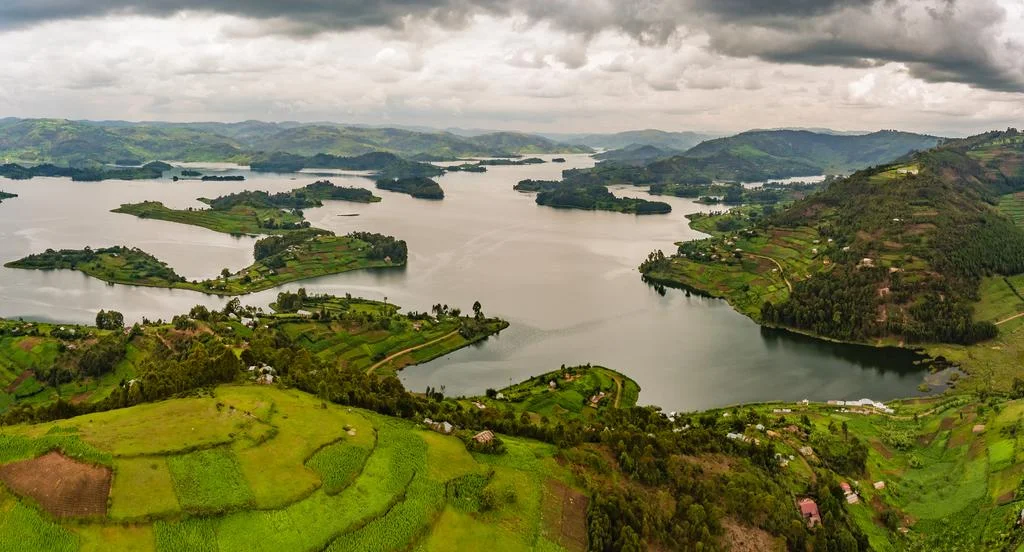
Combining Gorilla Habituation with Lake Bunyonyi. After up to four hours in Rushaga’s forest, working alongside researchers and trackers to observe a semi-habituated gorilla family, most travelers want exactly one thing: somewhere quiet to recover. Lake Bunyonyi, roughly two to three hours from Rushaga, is where a remarkable number of gorilla trekkers end up doing precisely that. Africa’s second-deepest lake, scattered with 29 islands and framed by terraced hills, offers a genuinely different kind of scenery and pace from the dense forest travelers have just left behind. At Pick and Transfer Safaris, this pairing is one of the more natural additions to a Gorilla Habituation Experience itinerary, and this guide explains how the two fit together.
Why Lake Bunyonyi Works So Well After Rushaga
The Gorilla Habituation Experience is physically demanding by design, up to four hours of forest hiking on Rushaga’s steep terrain, considerably more taxing than the standard one-hour gorilla trek. Lake Bunyonyi offers close to the opposite experience: calm water, gentle canoe rides, and activities that ask little of already tired legs. Sitting at an altitude of roughly 1,962 meters, the lake’s climate stays cool and comfortable year-round, and its bilharzia-free waters are safe for swimming, a detail many travelers appreciate after days of forest trekking without the option of a proper swim.
This contrast, physically demanding forest day followed by a genuinely restful lakeside stay, is why Lake Bunyonyi has become such a common addition to gorilla trekking itineraries generally, and the Gorilla Habituation Experience specifically, given how much more taxing that particular activity is than a standard trek.
The Route from Rushaga to Lake Bunyonyi
The journey from Rushaga to Lake Bunyonyi typically takes two to three hours by road, passing through Kisoro before joining the Kabale-Kisoro highway near Muko village, then continuing on to the lake’s shores. The road includes winding dirt sections and mountain terrain, so a 4×4 vehicle with an experienced driver is genuinely necessary rather than optional, particularly during the rainy season when the route can become considerably more difficult to navigate.
Given this is a considerably shorter transfer than the four-to-six-hour drive required to reach Queen Elizabeth National Park from Rushaga, Lake Bunyonyi tends to be the more practical add-on for travelers with limited additional time who still want a genuine change of pace after their forest day, rather than simply heading straight back to Kigali.
What There Is to Do at the Lake
Lake Bunyonyi’s signature activity is dugout canoeing, gliding across the water in a traditional wooden canoe, either self-paddled or guided, past the lake’s 29 islands. Several islands carry genuine historical weight worth knowing before you visit: Akampene, known as Punishment Island, was historically where unmarried pregnant women were abandoned by the Bakiga community, while Bwama Island once operated as a leprosy treatment camp established by an early twentieth-century missionary. A guide can walk you through these histories as you paddle past, adding real depth to what might otherwise be simply a scenic boat ride.
Beyond canoeing, the lake offers genuinely strong birdwatching, with over 200 recorded species, hiking trails through the surrounding terraced hills, including a popular route up to the Kashasha Hill viewpoint, and cultural encounters with the Bakiga and Batwa communities living around the lake’s shores. Several islands also host small homestays or community-run visits where travelers can spend an afternoon learning about local farming, fishing, and daily life on the water, a gentle contrast to the ranger-led structure of the preceding gorilla days. For travelers who simply want to sit still after a demanding forest day, several lakeside lodges are built specifically around that kind of quiet recovery, with little more required than a hammock, a book, and a view.
Structuring the Combined Trip
Given the physical demands of the Rushaga leg, a sensible structure allows for the habituation day, a short recovery period, and then the transfer to Lake Bunyonyi for a more relaxed final stretch of the trip. A workable four-day itinerary looks like this: travel from Kigali to Rushaga on day one, the Gorilla Habituation Experience on day two, transfer to Lake Bunyonyi on the morning of day three with the afternoon free for canoeing or simply resting, and a final relaxed morning at the lake on day four before returning to Kigali, since Lake Bunyonyi sits roughly two to three hours from the Rwandan border as well, making it a genuinely convenient final stop before departure rather than a detour.
This structure gives the forest day the recovery time it deserves without adding excessive additional travel days to the overall trip, since Lake Bunyonyi’s proximity to both Rushaga and the Kigali route keeps the logistics comparatively simple.
Where to Stay Around the Lake
Lake Bunyonyi offers accommodation across every budget tier, from basic camps like Bunyonyi Overland Resort and Bushara Island Camp to considerably more comfortable properties such as Arcadia Cottages and Lake Bunyonyi Rock Resort, several of which sit directly on the water or on their own private islands. Many lodges specifically cater to post-trek recovery, with warm meals, quiet settings, and easy access to canoe rentals directly from the property, which suits the pacing of this itinerary well given how demanding the preceding Rushaga day tends to be.
Island properties in particular offer a genuine sense of separation from the rest of the trip, reachable only by canoe or a short boat transfer arranged through the lodge, which many travelers find adds to the sense of having truly left the forest behind. For couples or small groups wanting more privacy after several days of shared ranger-led activities, these island lodges tend to be worth the modest premium over mainland options closer to the main Rutinda landing point.
Booking the Gorilla Habituation Permit First
As with any itinerary built around Rushaga, the Gorilla Habituation Experience permit remains the tightest constraint by a wide margin, with only eight permits available per day across the two families currently undergoing habituation, and full payment required at the time of booking. This should be confirmed well before finalizing the Lake Bunyonyi portion of the trip, though the lake itself involves no advance booking requirement beyond standard lodge reservations, making it a genuinely flexible piece to slot in once your gorilla permit date is locked in.
Extending Further
Travelers with more time sometimes combine Lake Bunyonyi with Mgahinga Gorilla National Park for golden monkey trekking, since Mgahinga sits within a similar range of both Rushaga and the lake, allowing all three, gorilla habituation, golden monkeys, and lakeside recovery, within a single, geographically compact circuit around Kisoro and Kabale districts.
Visa and Border Requirements
Since this trip typically begins and ends in Rwanda, the East African Tourist Visa tends to be the most convenient choice, covering multiple entries across Uganda, Rwanda, and Kenya over 90 days for 100 US dollars through Uganda’s official immigration portal. A standard single-entry Uganda Tourist Visa works just as well for travelers not planning to re-enter Rwanda. A valid yellow fever vaccination certificate is required for entry into Uganda regardless of visa type.
Planning Your Gorilla Habituation and Lake Bunyonyi Trip with Pick and Transfer Safaris
Pairing the Gorilla Habituation Experience with a stay at Lake Bunyonyi gives travelers exactly the kind of contrast a demanding forest day calls for, calm water, gentle activities, and genuine rest after four hours in Rushaga’s steep terrain. If you would like help confirming your Gorilla Habituation Experience permit, selecting a lodge suited to post-trek recovery at the lake, or arranging your private transfer between Rushaga, Lake Bunyonyi, and Kigali, get in touch through our Contact Us page. We’ll build the itinerary with proper recovery time built in, not just an efficient route between destinations.