- LET'S PLAN YOUR SAFARI
- +256 200 921 002
- +256 793 194 703
- info@pickandtransfersafaris.com

Two days gorilla tour in Uganda
Two days gorilla tour in Uganda. If a one-day gorilla trek sounds too rushed, but a full week feels like more than you need, two days is the sweet spot most travelers land on. A two days gorilla tour in Uganda gives you everything the single-day version offers, minus the exhaustion. You get an unhurried drive, a proper night’s sleep before the trek, and a calmer return journey, all while adding only one extra night to your trip.
This guide walks through how a two-day Uganda gorilla safari works when starting from Kigali. It covers what each day looks like, what it costs, what to pack, how to choose between Uganda’s trekking parks, and why it’s the itinerary we recommend most often to first-time trekkers. At Pick and Transfer Safaris, our 2 Days Uganda Gorilla Tour Starting from Kigali is exactly this trip, refined over hundreds of departures for travelers who want the full gorilla trekking experience without giving up half a week of their itinerary.
For those considering a two days gorilla tour in Uganda, it offers a unique opportunity to witness the majestic gorillas in their natural habitat.
Whether you’ve decided two days is right for you, or you’re still weighing it against a faster one-day dash or a longer combined safari, this guide answers every practical question that comes up in the weeks before departure. From what’s in your daypack to how the border crossing works to what happens in the sixty minutes you spend with the gorillas themselves.
Many travelers find that the two days gorilla tour in Uganda provides them with a more relaxed experience compared to other options.
When you choose a two days gorilla tour in Uganda, you are ensuring that you have ample time to enjoy the breathtaking scenery and wildlife.
Why Two Days Is the Sweet Spot for Gorilla Trekking from Kigali
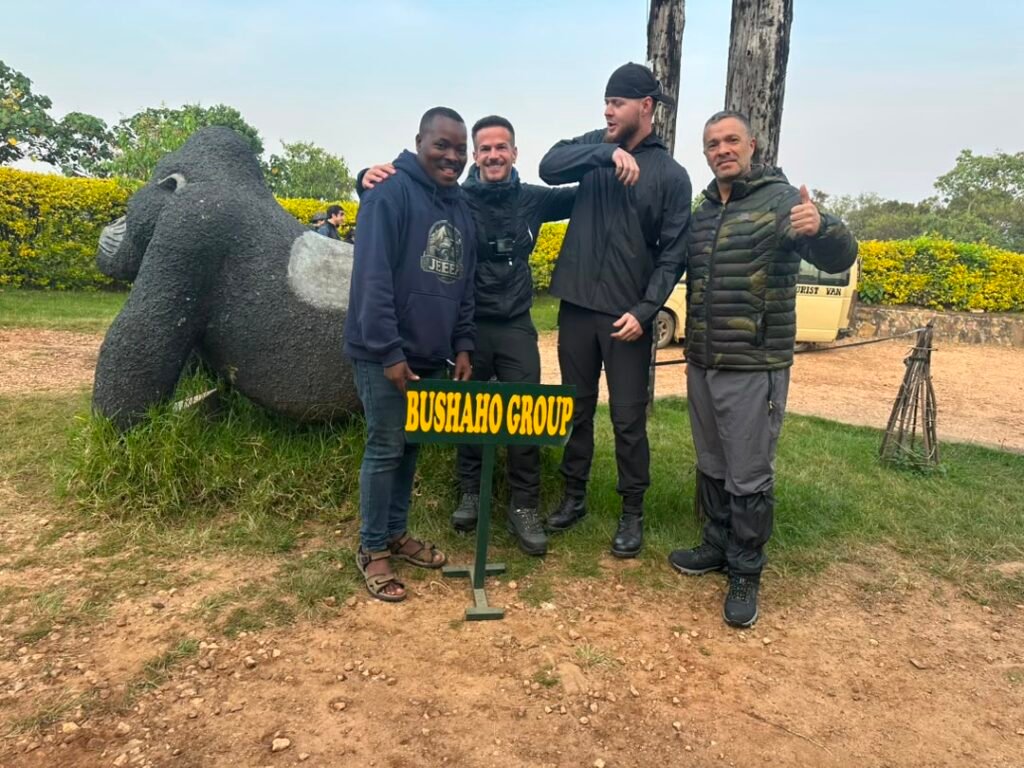
A two-day itinerary solves the two biggest complaints travelers have about the alternatives. Against a one-day tour, it removes the 3:30 am departure and the same-day 18-hour round trip. Instead, it offers a relaxed drive on day one, an overnight near the park, and a well-rested start to the trek itself on day two.
This is the gap our 2 Days Uganda Gorilla Tour Starting from Kigali is built to fill. It’s the gentler cousin of the one-day version — same idea, twice the breathing room, without stretching into a longer multi-activity safari. For most first-time trekkers weighing up their options, two days is the itinerary that best balances time, cost, and comfort.
The two days gorilla tour in Uganda allows you to fully immerse yourself in the culture and environment.
Embarking on a two days gorilla tour in Uganda can be a life-changing experience for many.
Day-by-Day: What a Two-Day Gorilla Tour Looks Like
Choosing the two days gorilla tour in Uganda ensures that you won’t feel rushed and can enjoy every moment.
With a two days gorilla tour in Uganda, travelers can also take advantage of additional experiences available in the area.
A two days gorilla tour in Uganda allows you to bond with fellow trekkers and share unforgettable memories.
During your two days gorilla tour in Uganda, you’ll be part of a group that shares your passion for wildlife.
Spreading the trip across two days changes the entire rhythm of the trip compared with a single-day dash, and it’s worth seeing exactly how the two days unfold.
Day 1 — Kigali to the Park. A comfortable mid-morning pickup from your Kigali hotel or the airport — typically 7:00–8:00 am rather than the 3:30 am start a one-day tour requires — followed by the drive southwest through Rwanda toward the Cyanika or Katuna/Gatuna border crossing into Uganda. Border formalities are usually straightforward with a guide managing the process, and the drive continues into Uganda’s Kigezi highlands, arriving at a lodge near your assigned trekking sector (Mgahinga, or Bwindi’s Rushaga or Nkuringo sectors) by early-to-mid afternoon. The rest of the day is free — time to settle in, rest after the drive, and get an early night ahead of tomorrow’s trek.
The memories made during a two days gorilla tour in Uganda will last a lifetime.
For those considering adventure, the two days gorilla tour in Uganda is highly recommended.
Day 2 — The Gorilla Trek and Return. An early breakfast and short transfer to park headquarters for the 7:00–7:30 am briefing, followed by the trek itself and your one hour with the gorillas once the family is located. After collecting your trekking certificate back at headquarters, a late lunch near the park precedes the return drive to Kigali, retracing the route across the border and arriving back in the early-to-mid evening.
Because the trek and the return drive both happen on day two, it’s still a long final day — but nothing like the compressed single-day version, since you’ve already banked a full night’s sleep before setting out. Many travellers describe day two as the day they came for and day one as the day that made it possible to actually enjoy it, rather than arrive at the trailhead already running on fumes.
Best Time of Year for a Two-Day Gorilla Tour
Gorilla trekking runs year-round, since gorilla families don’t migrate and permits are issued every month, but the season you travel in noticeably shapes how the two days feel.
The dry seasons — roughly June to September and December to February — offer firmer trails, less mud on the steep sections around Rushaga and Nkuringo, and generally easier driving conditions on the unpaved stretches near the park. They’re also the busiest months, which matters more for a two-day tour than a longer trip, since permits and the best-located lodges near your trekking sector can sell out two to three months ahead, and considerably earlier around the July–August and Christmas–New Year peaks.
The wet seasons — roughly March to May and October to November — bring heavier rain and muddier, more slippery trails, particularly in Bwindi’s dense forest interior, but also mean quieter parks, lower lodge rates, and lush, dramatic scenery on the day-one drive. Because the trek in wet season can occasionally run shorter — gorillas often stay closer to the forest edge when it’s raining — some travellers actually find their day-two schedule easier to manage in the off-peak months, provided they’ve packed proper rain gear.
Regardless of when you travel, both days involve driving through hill country and rainforest at altitude, where mornings are cold and afternoons can turn humid or wet within the same day — pack for all of it rather than relying on the season alone.
Mgahinga or Bwindi: Which Suits a Two-Day Trip Best
Both of Uganda’s gorilla trekking areas work comfortably within a two-day window from Kigali, and the extra day of buffer compared with a one-day tour makes the choice less pressured than it would otherwise be.
For those weighing trip lengths, seeing the trade-offs side by side can be beneficial. A two-day tour often proves to be the best choice for first-time trekkers, balancing comfort and experience.
Mgahinga Gorilla National Park has the shortest drive from Kigali, at roughly 3 hours, and hosts one habituated gorilla family alongside golden monkey tracking as an easy add-on if you have any spare time on day one afternoon or day two after the trek. Its smaller size and single family also mean trekking distances here tend to be more predictable than in the wider expanse of Bwindi, which can make Mgahinga a slightly more relaxed choice for travellers who want the shortest possible drive combined with a more contained trekking experience.
Bwindi’s southern sectors — Rushaga and Nkuringo — add perhaps 30–60 minutes of drive time each way but open up a much wider choice of habituated gorilla families, which usually means better permit availability, especially in peak season when Mgahinga’s single family sells out early. Rushaga alone hosts several habituated families and is also the base for Bwindi’s gorilla habituation experience for travelers wanting extended time with a not-yet-fully-habituated family, though that particular activity runs closer to four hours and sits outside the scope of a standard two days gorilla tour in Uganda. Bwindi’s forest is also denser, so treks here can run a little longer, but with a full two days to work with, that extra time is far less of a scheduling concern than it would be on a same-day itinerary.
If your travel dates are flexible, either park works well for two days; if you’re booking close to your travel dates during peak season, Bwindi’s broader permit availability often makes it the easier one to actually secure.
What Happens During Your Hour with the Gorillas
Everything on day two builds toward this single hour, so it’s worth knowing what actually happens once your group finds the family.
Trackers head into the forest at dawn, well before your group sets off, working from the gorilla family’s last known nesting site to locate them fresh each morning. Once your trekking group is within range — a process that can take anywhere from 30 minutes to several hours — bags, walking poles, and food are typically left with a support team a short distance away, and the final approach into the family’s immediate area is made quietly, in single file, at the guide’s pace.
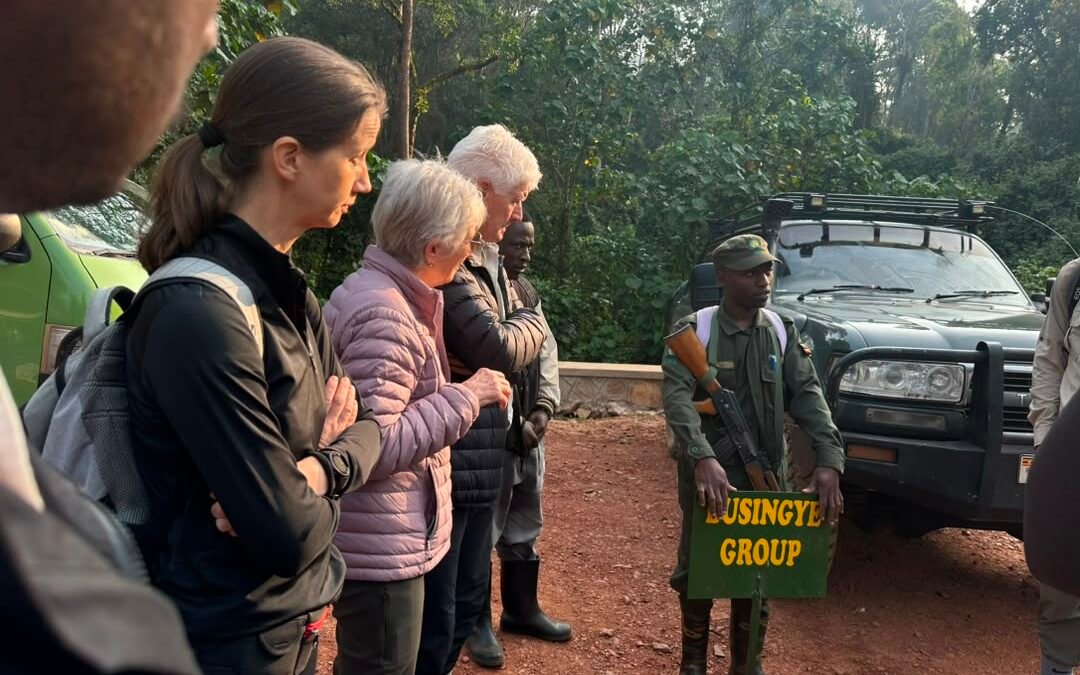
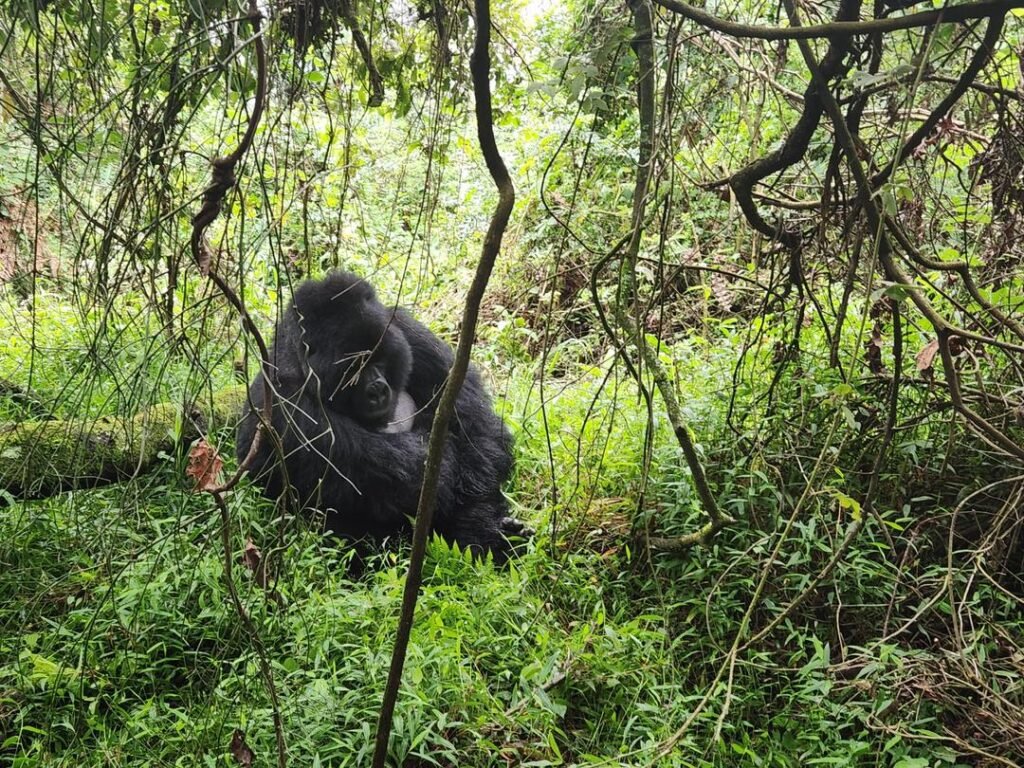
From there, you’ll spend up to one hour at a mandated distance of roughly 7 meters, watching the family forage, rest, groom each other, and interact — young gorillas in particular are often playful and unbothered by the group’s presence, while a resting silverback may barely acknowledge the visitors at all. Guides position the group for the best and safest viewing angles throughout, and it’s not unusual for a curious juvenile, or occasionally the silverback himself, to close the distance on his own terms; when this happens, the correct response is to stay still, stay quiet, and let the guide manage the moment.
When the hour is up, the guide signals the group to withdraw quietly, and the hike back to the trailhead begins. A trekking certificate is issued back at park headquarters, and for most visitors, this hour — however long the drive and the climb took to reach it — is the part of the whole two days they remember most vividly.
What to Pack for a Two-Day Gorilla Tour
Packing for two days is only marginally different from a one-day trip, since you’ll have an overnight stop to store the bulk of your luggage before heading into the forest with just a daypack.
- Sturdy, broken-in hiking boots with good ankle support.
- Long trousers and a long-sleeved shirt to protect against nettles and insects on the trail.
- Gardening or trekking gloves for gripping vegetation on steeper sections.
- A waterproof rain jacket, since rain is possible at the lodge, on the drive, or during the trek in any season.
- A warm layer for the cool early-morning briefing on day two.
- A small daypack for water, snacks, camera, and permit documents — this is what actually goes into the forest with you.
- A change of clothes and basic toiletries for the overnight stay, kept separate from your trekking daypack.
- Cash in US dollars for porter tips (around $15–20), lodge incidentals, and any border fees.
- Your passport, visa documentation, and permit confirmation.
Because you’re not carrying everything for the whole day in one bag, as on a one-day tour, it’s worth packing a proper overnight bag for the lodge and a lean daypack for the trek itself — most lodges are happy to store the larger bag while you’re in the forest.
Visa, Permit, and Border Crossing Requirements
The same cross-border rules apply here as on any Kigali-to-Uganda gorilla itinerary. Most nationalities will want either the East Africa Tourist Visa, which permits multi-entry travel across Rwanda, Uganda, and Kenya on a single visa, or a single-entry Ugandan visa obtained online in advance or on arrival at the border. With a full two days rather than one compressed day, there’s more comfortable margin for border processing, but applying for your visa before you land in Kigali is still the safer, lower-stress option.
Your gorilla permit — around $700–800 for foreign non-residents — needs to be booked well ahead of your travel dates regardless of trip length, ideally two to three months out and considerably earlier during July–August and the December peak. A yellow fever vaccination certificate is required for entry into both Rwanda and Uganda, so keep a printed copy with your travel documents.
Border crossing itself, at either Cyanika or Katuna/Gatuna depending on your assigned trekking sector, typically involves standard exit and entry stamps on both sides, a brief vehicle check, and — with a guide handling the process — usually takes somewhere between 20 and 60 minutes depending on how busy the post is that morning. Both crossings are used regularly by tourist vehicles heading to and from the parks, and immigration staff at both are generally accustomed to processing gorilla trekking travellers efficiently.
How Physically Demanding Is a Two-Day Tour?
Considerably more manageable than the one-day version, simply because the drive and the trek are no longer competing for the same day’s energy. You’ll arrive at the trailhead on day two rested rather than having already been awake since 3:30 am, which makes a genuine difference on terrain that can be steep, muddy, and physically demanding regardless of how the rest of your day has gone.
The trek itself remains moderate to strenuous — expect anywhere from 30 minutes to several hours of hiking at altitudes between roughly 1,800 and 2,900 metres, depending on where the gorilla family has moved that morning. Porters are available at every trailhead (around $15–20) and are worth hiring regardless of fitness level, both for the practical help on steep or slippery sections and because the fee supports the local community directly. If mobility is a concern, sedan-chair transport can be arranged in advance, and it’s worth mentioning any concerns to your operator when booking so your permit can be matched to a gorilla family known to range closer to the trailhead.
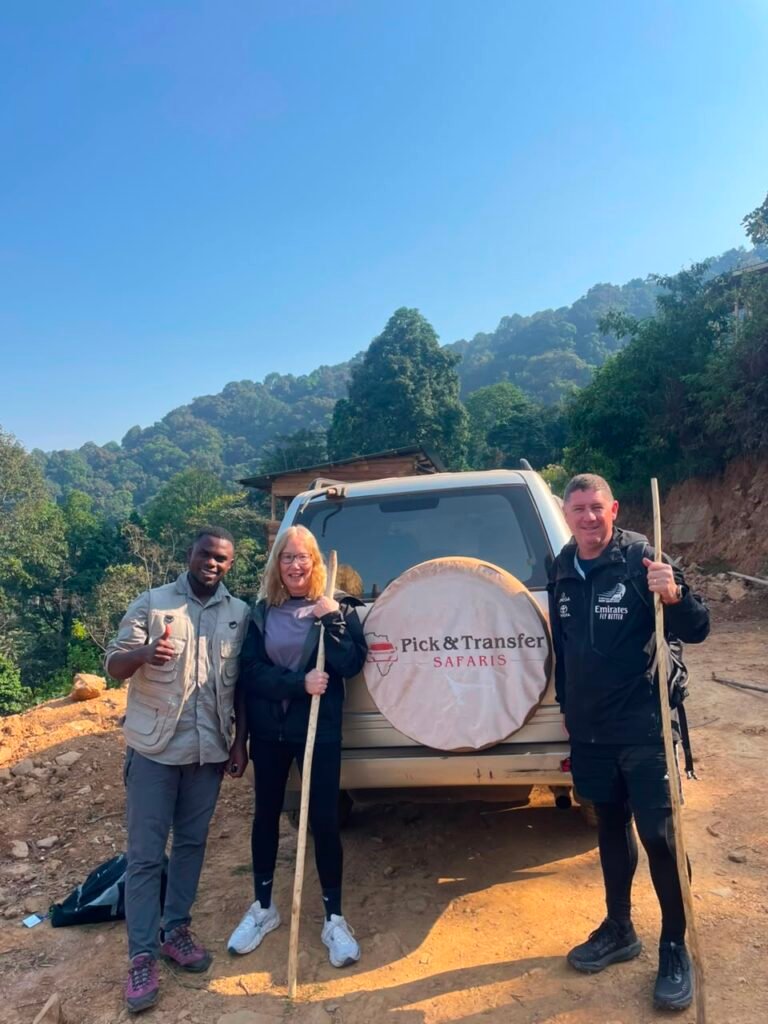
Trekking poles — either brought from home or rented cheaply at park headquarters — are genuinely useful on both the ascent and, especially, the descent, and are worth taking even if you don’t think you’ll need them. If you’re travelling in the wet season, expect the terrain to add a meaningful layer of difficulty on top of the incline itself, simply from mud and slippery footing, so it’s worth adjusting your expectations for pace rather than assuming fitness alone will offset the conditions.
Gorilla Trekking Rules and Etiquette
Mountain gorillas are critically endangered and highly susceptible to human respiratory illness, which is why both days of your trip — but especially day two — are governed by a strict set of rules designed to protect them as much as visitors.
- Maximum group size of eight visitors per gorilla family, per day.
- Maximum time with the gorillas of one hour, regardless of how long the hike in took.
- Minimum distance of roughly 7 metres, though gorillas themselves sometimes close that gap voluntarily.
- No trekking while unwell — visitors showing signs of a cough, cold, or flu are asked not to trek, for the gorillas’ safety as much as other visitors’.
- No flash photography, and voices kept low throughout the encounter.
- No eating, drinking, or smoking in the immediate presence of the gorillas.
- Minimum age of 15, in line with both UWA and RDB policy.
- Turn away and cover your mouth if you need to cough or sneeze during the trek.
Rangers and guides manage the encounter closely throughout, and following their instructions immediately — without exception — is what keeps the experience safe for everyone, gorillas included.
Health, Vaccinations, and Safety on a Two-Day Trip
Beyond the yellow fever certificate required for entry into both Rwanda and Uganda, a few additional health precautions are worth sorting out before you travel. Malaria is present in both countries at the elevations surrounding the trekking parks, though risk is somewhat lower at higher altitude than in the lowland regions further away, and most travel health advisories still recommend antimalarial prophylaxis for the trip. Routine vaccinations — tetanus, hepatitis A and B, typhoid — are commonly recommended for the wider region, and it’s worth raising this with a doctor or travel clinic four to six weeks ahead of departure, since some vaccines need lead time to take effect.
Mountain gorillas are genetically close to humans, making them susceptible to similar respiratory illnesses, prompting park authorities to prohibit visibly unwell trekkers from entering the forest. If symptoms arise before your trek, inform your operator, as permits may be rescheduled depending on availability. It’s advisable to have travel insurance that covers trekking at altitude and potentially the permit cost in case of illness-related cancellations, while also carefully reviewing the policy as not all general travel insurance includes coverage for adventure activities like gorilla trekking without an added rider.
Responsible and Sustainable Gorilla Tourism
Mountain gorillas are one of conservation’s genuine good-news stories: their population has grown from under 300 individuals in the 1980s to just over 1,000 today, a recovery driven directly by the revenue and protection that regulated tourism provides. A significant share of every permit fee is reinvested into park protection, anti-poaching patrols, and community revenue-sharing schemes that fund schools, clinics, and infrastructure in the villages bordering the parks.
Hiring a local porter for your day-two trek, even if you don’t strictly need the physical assistance, is one of the most direct ways an individual traveller supports that community economy — porter fees go straight to local families, many of whom depended on the forest for farming before it became a protected park. Respecting the rules above isn’t bureaucratic box-ticking; it’s the actual mechanism that keeps this recovery on track, and operators who take it seriously tend to be the ones worth booking with.
Photography Tips for Your Trek
With only one hour in front of the gorillas at the end of day two, it’s worth thinking through your camera setup in advance rather than fumbling with settings once you’re there. Low light is the main technical challenge, since the forest canopy filters out much of the available light and flash is prohibited — a camera capable of shooting at a higher ISO without excessive noise, or a fast lens around f/2.8, makes a real difference. A mid-range zoom, roughly 70–200mm equivalent, tends to be more useful than an ultra-telephoto, since gorillas are often much closer than the mandated distance suggests once they move on their own accord.
Bring spare batteries and a spare memory card, since there’s no opportunity to recharge anything mid-trek, and keep your camera in a dry bag or rain cover given the real chance of rain during the hike. Most guides also encourage putting the camera down for at least part of the hour — it’s easy to spend the whole encounter behind a viewfinder and realise afterward you barely watched the moment itself.
How Much Does a Two-Day Gorilla Tour Cost?
A two-day Uganda gorilla tour from Kigali typically covers the gorilla permit, one night’s accommodation near the park, a 4×4 vehicle with driver-guide for both days, fuel, park fees, and meals. As a rough working figure, expect a total in the region of $1,000–$1,400 per person for a mid-range lodge and a shared vehicle, with private vehicles or upgraded lodges pushing that figure higher.
The gorilla permit is the largest expense at approximately $700–800 per person for foreign non-residents, set by the Uganda Wildlife Authority. Ground transport costs between $150–300 per person, varying based on vehicle type and sharing arrangements. Accommodation near the park ranges from $50–80 for budget options to several hundred dollars for upscale lodges, allowing for flexibility based on budget. Additional costs include meals, porter tips (approximately $15–20), and optional activities like golden monkey tracking or cultural visits.
Compared with the one-day version, the extra cost of the additional night’s accommodation is often offset by a calmer, lower-risk itinerary and a genuinely more enjoyable trekking day — most travellers who’ve done both agree the marginal cost is well worth it. Travelling as a couple or small group also brings the per-person transport cost down noticeably, since the vehicle and driver-guide fee is shared across the group rather than charged per traveller.
On payment logistics, most operators require a deposit at booking, largely because the permit itself has to be paid for and secured with UWA well ahead of your arrival, with the balance due closer to travel or on arrival. US dollars in cash — newer notes in good condition — remain widely preferred for tips and incidentals at both the lodge and the park, so it’s worth arriving with a reasonable supply rather than relying on cards, which aren’t reliably accepted outside Kigali.
What’s Typically Included and Excluded
Understanding exactly what a quoted price covers avoids surprises once you’re on the road. A well-packaged two-day tour typically includes the gorilla permit, ground transport in a 4×4 vehicle with driver-guide for both days, one night’s accommodation near the park on a bed-and-breakfast or half-board basis, park entrance fees, and airport or hotel pickup and drop-off in Kigali. It typically excludes international flights, visa fees, travel insurance, porter and guide tips, alcoholic drinks and any meals not specified in the itinerary, and optional add-ons like golden monkey tracking or a Batwa cultural visit.
It’s worth asking specifically whether the border crossing fees and any Uganda entry costs are included in the quoted price or handled separately at the border, since this varies between operators and is easy to overlook when comparing quotes. A clear, itemised quote — rather than a single bundled figure — makes it much easier to compare two operators’ pricing on a like-for-like basis, and it’s reasonable to ask for that breakdown in writing before you pay a deposit.
Getting to Kigali Before Your Tour
Since every two-day gorilla tour covered in this guide begins in Kigali, it’s worth a brief word on arrival logistics. Kigali International Airport receives direct flights from several European hubs, the Middle East, and major African cities, making it a genuinely convenient entry point regardless of where you’re travelling from. If your flight lands in the afternoon or evening, booking a night in Kigali before your tour begins — rather than attempting an early departure straight off a long-haul flight — is worth the modest extra cost, both to adjust to the time zone and to build in a buffer against any flight delay.
Many travellers also use this pre-tour night to see a little of Kigali City itself, consistently ranked among Africa’s cleanest and safest capitals, with the Kigali Genocide Memorial and a walkable, café-filled city centre both worth an afternoon if your schedule allows it. Your tour operator can typically arrange this pre-tour night and pickup as part of a single seamless booking, so you’re not coordinating separate hotel and tour logistics yourself.
Choosing Where to Stay for the Night
Because your overnight stop sits between the two most important parts of the trip — the drive and the trek itself — it’s worth choosing a lodge based on its proximity to your assigned park headquarters rather than on luxury alone. Mid-range lodges near Bwindi’s southern sectors or Mgahinga strike a good balance of comfort and price for a one-night stay, and many sit close enough to the trailhead that the morning transfer to the briefing takes well under an hour.
Combining a Two-Day Tour with Other Experiences
Two days leaves a little more room than a one-day tour to add a short extra activity without derailing the schedule. A visit with the local Batwa forest community, offering guided walks and cultural performances, fits naturally into the afternoon after your trek if your return drive timing allows, and golden monkey tracking is a straightforward add-on if your permit is at Mgahinga. Both activities are typically priced separately from the core gorilla tour, so it’s worth flagging interest at the booking stage rather than trying to arrange them on the ground.
If you find yourself wanting more time in the region than two days allows, our 3 Days Uganda Gorilla Safari from Rwanda builds in exactly this kind of cultural stop, and our 5 Days Uganda Gorilla and Chimps Safari starting from Rwanda pairs the trek with chimpanzee tracking in Kibale Forest for travellers with a full week to spend. For travellers who’d rather stay entirely within Rwanda instead of crossing the border, our 5 Days best of Rwanda Primate Safari covers similar ground without the Uganda leg at all.
You can compare every itinerary length side by side on our Gorilla Safaris starting from Kigali page. For an independent perspective on how other operators structure the same Kigali-to-Bwindi route and pricing, Kenlink Tours also publish detailed notes on permit costs and trekking sectors worth reading alongside this guide.
Choosing the Right Tour Operator for a Two-Day Trip
Because your gorilla permit is non-refundable and tied to a specific date, and because the two-day itinerary depends on a lodge booking near the correct trekking sector and a smooth border crossing, the operator you choose matters more here than on a trip within a single country.
A few concrete questions are worth asking before you commit: Can they name the specific trekking sector — Mgahinga, Rushaga, or Nkuringo — your permit is likely to be assigned to, and is the lodge they’ve quoted actually near that sector rather than a generic placeholder? Do they book the permit directly with UWA and can they show confirmation once it’s secured, rather than promising to “sort it closer to the date”? Is the vehicle a proper 4×4, given the unpaved stretches near some trekking sectors?
The two days gorilla tour in Uganda allows you to fully immerse yourself in the culture and environment, enriching your travel experience.
At Pick and Transfer Safaris, our two-day packages are built specifically around this logistics chain — permit booking, lodge selection matched to your trekking sector, and a vehicle suited to the terrain — because getting each of those details right is what makes the difference between a smooth two days and a stressful one.
Common Mistakes to Avoid on a Two-Day Gorilla Tour
A handful of avoidable mistakes account for most of the problems travellers run into on this itinerary, and knowing them in advance is the easiest way to sidestep them entirely rather than learning them the hard way partway through the trip.
Booking the permit too late. Gorilla permits sell out months ahead during peak season, and a two-day tour offers no flexibility to simply “try again tomorrow” if your preferred date is unavailable — book two to three months out at minimum, longer for July–August or December travel.
Choosing a lodge for its amenities rather than its location. A beautiful lodge that’s an hour further from park headquarters than necessary can mean a rushed, stressful morning on day two — proximity to your specific trekking sector should outweigh other considerations for this one night.
Skipping travel insurance that covers trekking and permit cancellation. Illness, injury, or an unexpected delay can force a change of plans, and without the right cover, a non-refundable permit becomes a significant loss.
Underestimating the cold at altitude. Many travellers pack for equatorial heat and are caught off guard by how cold the early-morning briefing and the first hour of the trek can feel — a proper warm layer is not optional.
Not sorting visa documentation in advance. Arriving at the border without pre-approved visa paperwork can add unpredictable delays that eat into an already tight day-two schedule.
Forgetting cash for tips. Card payments are unreliable outside Kigali, and porters, guides, and drivers are typically tipped in US dollars cash — bring more small denominations than you think you’ll need.
Assuming any vehicle will do. A standard sedan or minivan struggles on the unpaved stretches near some trekking sectors; confirm you’re travelling in a proper 4×4 rather than discovering the mismatch on the road itself.
Two Days vs. One Day vs. Longer Itineraries: A Quick Comparison
If you’re still deciding between trip lengths, it helps to see the trade-offs side by side rather than in isolation.
A one-day tour compresses everything into a single 18–20 hour day with a 3:30 am departure — the fastest and often the cheapest option in terms of avoiding an extra night, but the most physically demanding and the least forgiving of delays. Our full breakdown of that itinerary is worth reading if you’re weighing it against the two-day version.
A two-day tour, as covered throughout this guide, removes the pre-dawn start and the single-day fatigue in exchange for one extra night’s cost, and is the itinerary most first-time trekkers settle on once they compare the two side by side.
A three-day or longer itinerary adds room for a cultural visit with the Batwa community, a second primate encounter like chimpanzee tracking, or a wildlife-focused stop at Queen Elizabeth National Park, without needing to rush any single element. Our 3 Days Uganda Gorilla Safari from Rwanda and 5 Days Uganda Gorilla and Chimps Safari starting from Rwanda are worth a look if two days turns out to feel like just enough time to wish you had a little more.
Frequently Asked Questions
Is two days enough time to properly enjoy a gorilla trek from Kigali? Yes — it’s the itinerary length most first-time trekkers choose specifically because it removes the fatigue of a one-day tour while adding only a single night to the trip.
Do I need to book my lodge separately, or is it included in the tour price? With a properly packaged two-day tour, accommodation near the park is included in the quoted price, matched to your specific trekking sector to minimise the morning transfer time.
Can I add golden monkey tracking to a two-day gorilla tour? Yes, if your permit is at Mgahinga — golden monkey tracking is shorter and less expensive than gorilla trekking and can often be slotted into the same two days with the right timing.
What if it rains during my trek? The trek proceeds regardless of weather, since permits are date-specific and non-refundable for rain — proper rain gear, covered earlier in the packing list, is essential rather than optional.
Should I book two days or one if I’m not sure I can spare the extra night? If you can find even one extra night, the two-day version is almost always worth it — the difference in comfort and reduced risk of missing the morning briefing is significant for a relatively small increase in cost and time.
How far in advance should I book a two-day gorilla tour? At least two to three months ahead for regular travel dates, and four to six months ahead for July–August or the December holiday period, when both permits and well-located lodges near the park sell out fastest.
Can I do a two-day gorilla tour with children? Uganda’s minimum age for gorilla trekking is 15, in line with UWA policy, so younger children would need to stay at the lodge with a caregiver, or the family would need to consider a longer itinerary with alternative activities built in for them.
What’s the difference between trekking in Mgahinga and Bwindi on a two-day trip? Mgahinga has the shortest drive from Kigali and pairs naturally with golden monkey tracking, but hosts only one gorilla family, so availability can be tighter. Bwindi’s southern sectors add a little drive time but offer far more habituated families to choose from.
Is the border crossing between Rwanda and Uganda difficult? Not typically. The crossings used for this route — Cyanika and Katuna/Gatuna — are quieter, tourist-familiar posts, and with a guide handling the paperwork, the process usually takes well under an hour.
Do I need travel insurance for a two-day gorilla tour? It’s strongly recommended, specifically insurance that covers trekking at altitude and, ideally, the cost of the permit itself in case illness or an emergency forces you to cancel or reschedule.
Can I use a two-day gorilla tour as a stopover between other trips? Yes — many travellers use it exactly this way, sandwiching it between a Rwanda-based trip and an onward flight, or as a short add-on to a longer East Africa itinerary, since it begins and ends in Kigali.
What happens if I miss the morning briefing on day two? Arriving after the cutoff, typically 7:00–7:30 am, risks being reassigned to a less convenient gorilla family or, in rare cases, losing your place on the trek for that day, which is why lodge proximity to park headquarters matters so much on this itinerary.
Will I definitely see the gorillas once I start trekking? Sightings are close to guaranteed once trekking begins, since trackers locate the family before your group sets off, but the amount of walking required to reach them varies considerably from day to day.
Final Thoughts
A two-day gorilla tour in Uganda gives you the same forest encounter as any longer itinerary, without the compressed exhaustion of a single-day dash or the extra time commitment of a longer trip. It’s the itinerary length we recommend to most first-time trekkers weighing up their options from Kigali, and with a permit booked early and the right lodge matched to your trekking sector, it runs smoothly from start to finish.
The details that matter most — booking your permit two to three months ahead, choosing a lodge close to your assigned trekking sector rather than the most scenic one on the map, packing properly for cold mornings and possible rain, and working with an operator who handles the border crossing as routinely as the drive itself — are the same details that separate a smooth, memorable two days from a stressful one. Get them right, and the hardest part of the whole trip ends up being the hour you spend wishing you had longer with the gorillas before it’s time to walk back out of the forest.
If you’d like help matching this itinerary to your travel dates and securing permit availability at Mgahinga or Bwindi, get in touch with our team and we’ll build the two-day plan around your schedule.
If you’re still deciding between trip lengths, it helps to see the trade-offs side by side rather than in isolation. A two-day tour is usually the best option for first-time trekkers looking for a balanced itinerary.
A two-day gorilla tour in Uganda gives you the same forest encounter as any longer itinerary. It’s the itinerary length we recommend to most first-time trekkers weighing up their options from Kigali, as it runs smoothly from start to finish.
Get the details right, and the hardest part of the trip ends up being the hour you spend wishing you had longer with the gorillas before it’s time to walk back out of the forest.
If you’d like help matching this itinerary to your travel dates and securing permit availability at Mgahinga or Bwindi, get in touch with our team and we’ll build the two-day plan around your schedule.
A two-day gorilla tour in Uganda offers the same exhilarating forest experience as longer itineraries. It’s recommended for first-time trekkers looking for a smooth and enjoyable adventure.
Get the details right, and you might find that the most challenging part of your trip is wishing for more time with the gorillas before returning from the forest.
If you want assistance customizing this itinerary to your travel dates and securing permit availability at Mgahinga or Bwindi, connect with our team for a tailored two-day plan.