- LET'S PLAN YOUR SAFARI
- +256 200 921 002
- +256 793 194 703
- info@pickandtransfersafaris.com

Uganda Tours Beginning from Kigali
Uganda Tours Beginning from Kigali. For a growing number of international travelers, the smartest way into Uganda is not through Entebbe at all — it’s through Kigali. Rwanda’s capital has quietly become one of East Africa’s most convenient gateway cities. For travelers heading toward Uganda’s gorilla parks in the country’s far southwest, starting the journey from Kigali rather than Entebbe can save an entire day of driving, sometimes more. This guide explains why Kigali has become such a popular starting point for Uganda tours. It walks through every practical detail of how a Kigali-based itinerary actually works. Additionally, it lays out the full range of trip lengths and routes available, from a single intense day to a full multi-country circuit spanning several weeks.
For those planning Uganda Tours Beginning from Kigali, it is essential to consider the various itineraries available.
Uganda Tours Beginning from Kigali are increasingly popular among tourists seeking unique experiences.
Why Kigali Has Become East Africa’s Favorite Gateway City
Many travelers opt for Uganda Tours Beginning from Kigali to experience the breathtaking landscapes and wildlife.
Exploring Uganda Tours Beginning from Kigali
Choosing Uganda Tours Beginning from Kigali allows visitors quick access to the renowned gorilla trekking experience.
We offer tailored Uganda Tours Beginning from Kigali that cater to each traveler’s preferences.
For those interested, Uganda Tours Beginning from Kigali can be combined with other regional adventures.
Travelers are now discovering the benefits of Uganda Tours Beginning from Kigali.
Many people are choosing Uganda Tours Beginning from Kigali for more efficient travel plans.
With Uganda Tours Beginning from Kigali, the journey is both enjoyable and memorable.
When considering Uganda Tours Beginning from Kigali, it’s helpful to have a detailed itinerary.
Our team specializes in creating Uganda Tours Beginning from Kigali that highlight the best experiences.
We recommend exploring Uganda Tours Beginning from Kigali for an extraordinary adventure.
Kigali International Airport has grown steadily over the past decade into one of the best-connected airports in East Africa. It has a strong network of direct and one-stop flights from Europe, the Middle East, and increasingly North America. That connectivity alone would make it an attractive entry point. However, the real reason Kigali has become so central to Uganda tourism planning is geography, not aviation.
Many travelers are eager to experience Uganda Tours Beginning from Kigali for its unique offerings.
The appeal of Uganda Tours Beginning from Kigali is evident in the growing number of visitors.
For a truly unique experience, consider Uganda Tours Beginning from Kigali.
Traveling with us means you’ll enjoy the best Uganda Tours Beginning from Kigali.
Many recommend Uganda Tours Beginning from Kigali for their ease and convenience.
Choosing Uganda Tours Beginning from Kigali truly enhances the travel experience.
For unforgettable memories, many choose Uganda Tours Beginning from Kigali for their adventure.
Those who embark on Uganda Tours Beginning from Kigali are often surprised by the experiences.
Uganda’s two mountain gorilla trekking destinations, Bwindi Impenetrable National Park and Mgahinga Gorilla National Park, both sit tucked into the far southwestern corner of the country. They are hard against the Rwanda border. Entebbe, Uganda’s main international airport, sits roughly at the opposite end of the country, near Lake Victoria. The overland drive from Entebbe to Bwindi typically takes nine to eleven hours. This depends on the specific trailhead sector and road conditions. The same journey from Kigali can be completed in as little as three to four hours. The border crossing points nearest to Kigali sit much closer to the gorilla parks than Uganda’s own capital region does.
This single geographic fact reshapes how a large share of international travelers now plan their trip. Instead of flying into Entebbe and absorbing a long transfer day before ever reaching the forest, many visitors fly into Kigali. They cross into Uganda by road the same day or the following morning. This allows them to be tracking gorillas within 24 to 48 hours of landing in East Africa. For travelers with limited vacation time, or those hoping to combine a Uganda gorilla trek with a Rwanda safari on the same trip, this routing genuinely changes what is achievable within a short window. It does so without sacrificing the depth of the experience.
Every itinerary for Uganda Tours Beginning from Kigali is crafted with care to ensure satisfaction.
At Pick and Transfer Safaris, we noticed this shift toward Kigali-based travel early, and rather than simply treating Kigali as an alternative airport for the same old Entebbe-based routes, we built a dedicated set of itineraries specifically designed around Kigali as the starting and ending point.
Comparing Kigali and Entebbe as Starting Points
Join us for Uganda Tours Beginning from Kigali as we explore the best of the region.
Experience the thrill of Uganda Tours Beginning from Kigali firsthand.
We continuously strive to provide the best Uganda Tours Beginning from Kigali.
Your journey begins with Uganda Tours Beginning from Kigali and promises adventures galore.
Travelers can now plan more efficiently, taking advantage of the shorter travel times and the ease of crossing borders. This shift also encourages a more profound exploration of both countries, enriching the travel experience.
Let us guide you through Uganda Tours Beginning from Kigali for a seamless experience.
Travelers rave about the unforgettable Uganda Tours Beginning from Kigali.
From start to finish, Uganda Tours Beginning from Kigali ensure a fulfilling experience.
Start your adventure with our expertly designed Uganda Tours Beginning from Kigali.
It’s worth being direct about the trade-offs, since Entebbe remains the right choice for some travelers.
Every traveler deserves the opportunity for Uganda Tours Beginning from Kigali for a unique experience.
Explore the majesty of the region with Uganda Tours Beginning from Kigali.
Kigali wins on: driving time to Bwindi and Mgahinga, road quality along the southern approach into Uganda, and convenience for anyone also visiting Rwanda’s attractions. Kigali itself is also widely regarded as one of the cleanest, safest, and most walkable capital cities in Africa. This makes it a genuinely pleasant place to spend a day or two before or after a trek, rather than a city travelers simply pass through.
Be part of the growing trend with Uganda Tours Beginning from Kigali to unlock unforgettable experiences.
For those interested in unique adventures, Uganda Tours Beginning from Kigali are ideal.
Experience the beauty of nature with Uganda Tours Beginning from Kigali.
We ensure that all Uganda Tours Beginning from Kigali are memorable and rewarding.
Join the many travelers opting for Uganda Tours Beginning from Kigali for their next adventure.
Entebbe wins on: direct access to Uganda’s other major parks. Queen Elizabeth National Park, Murchison Falls National Park, and Kibale Forest National Park all sit considerably closer to Entebbe than to Kigali, so travelers whose itinerary centers primarily on Uganda’s Big Five circuit and northern parks, rather than gorilla trekking specifically, often still find Entebbe the more efficient starting point.
Border Crossings Explained: Cyanika and Katuna
Two land border points handle the vast majority of overland traffic between Rwanda and southwestern Uganda. The Cyanika border crossing sits closest to Mgahinga Gorilla National Park and the town of Kisoro, making it the natural choice for travelers heading specifically to Mgahinga or combining a trip with Rwanda’s Volcanoes National Park just across the border. The Katuna crossing, somewhat further north, is the more commonly used route for travelers heading to Bwindi Impenetrable National Park, particularly its Ruhija and Buhoma sectors, and also serves as the main crossing point for travelers continuing further north toward Queen Elizabeth National Park.
Both crossings are generally efficient and well-organized, especially for travelers with documents prepared in advance. Kenlink Tours’ own guide to visa and border crossing procedures between Uganda and Rwanda lays out the practical requirements travelers should expect at these crossings, including passport validity, visa documentation, and the yellow fever vaccination certificate that is checked at most East African border points. Having these documents organized and easily accessible before arriving at the border noticeably speeds up the crossing process, particularly during busier travel periods.
Visa Requirements for a Kigali-Starting Uganda Trip
Because a Kigali-starting Uganda trip almost always involves crossing at least one international border, visa planning deserves more attention than it would on a single-country trip. Most international travelers require a visa for both Rwanda and Uganda, though specific requirements vary by nationality. The East Africa Tourist Visa, a joint visa arrangement between Rwanda, Uganda, and Kenya, is worth serious consideration for travelers on a Kigali-starting itinerary, since it permits multiple entries across these three countries on a single visa, which is considerably more convenient than obtaining separate single-entry visas for each border crossing. Kenlink Tours’ overview of the East Africa Tourist Visa walks through the application process for travelers entering the region from each of the three participating countries.
Whichever visa route you choose, apply well before departure rather than planning to sort documentation at the border. Standard single-entry visas for Uganda and Rwanda can typically be obtained online in advance or on arrival, but the East Africa Tourist Visa in particular should be arranged ahead of time to avoid delays.
Choosing How Long Your Trip Should Be
Embrace the thrill of exploration with Uganda Tours Beginning from Kigali.
One of the genuine advantages of starting from Kigali is how much flexibility it offers across different trip lengths. Because the drive to the gorilla parks is short, even a single day is enough to complete a full trek and return, something that would be essentially impossible starting from Entebbe. At the other end of the spectrum, Kigali also functions as a natural hub for building much longer regional circuits spanning Uganda, Rwanda, and beyond. The sections below walk through the full range, from shortest to longest.
The One-Day Option: For Travelers on a Tight Schedule
For travelers with only a single free day between flights, or those unwilling to give up more time than absolutely necessary, our One-Day Uganda Gorilla Safari Starting from Kigali packs an early border crossing, a full gorilla trek, and the return drive into one genuinely long but entirely achievable day. This option demands an early start, generally well before sunrise, and involves a considerable amount of driving on both ends of the trek itself, but it delivers the complete gorilla trekking experience without requiring an overnight stay near the park. It is best suited to fit, well-rested travelers who are comfortable with a demanding day, and who are not also trying to sightsee extensively in Kigali on the same visit.
The Two-Day Option: A More Comfortable Pace
For travelers who would rather not compress everything into 24 hours, the 2 Days Uganda Gorilla Tour Starting from Kigali spreads the same core experience over two calmer days, with an overnight stay near the park rather than a same-day return dash. This small adjustment makes a meaningful difference to the overall experience: travelers arrive at the trailhead already rested rather than after a pre-dawn drive, and the return journey to Kigali the next day feels considerably less rushed. For travelers weighing the one-day against the two-day version, the additional night is generally worth the extra cost for anyone who values comfort over sheer speed.
If Rwanda’s own Volcanoes National Park is of interest instead of, or alongside, Uganda’s gorilla parks, our 2 Days Volcanoes Gorilla Trek from Kigali offers a comparable short structure entirely within Rwanda, useful for travelers who want to keep their itinerary within a single country while still enjoying a Kigali-based short trip.
The Three-Day Option: Room to Breathe
Adding a third day opens up considerably more flexibility. Our 3 Days Uganda Gorilla Safari from Rwanda gives travelers a full day of travel and settling in before the trek itself, the trekking day, and a more relaxed return journey, without the sense of rushing that can characterize the shorter options. This extra breathing room also creates space for travelers to properly experience the drive itself, which passes through genuinely striking scenery on both sides of the border, rather than treating the transfer purely as a logistical necessity.
For travelers interested in Rwanda’s gorillas specifically, combined with a cultural component, our 3 Days Rwanda Gorilla Tracking and Cultural Tour follows a similar three-day structure while staying within Rwanda and adding a community visit alongside the trek itself.
The Five-Day Option: Gorillas, Chimps, and More
Travelers with five days available can go considerably further than a single primate encounter. Our 5 Days Uganda Gorilla and Chimps Safari Starting from Rwanda combines gorilla trekking in Bwindi with chimpanzee tracking, giving travelers two of Uganda’s signature primate experiences on a single Kigali-based loop, without needing to return to Kigali and set out again for a second trip. This kind of multi-activity routing from Kigali has become increasingly common across the industry; Kenlink Tours’ own multi-day itinerary from Kigali covering Bwindi, Queen Elizabeth, Kibale, and Lake Bunyonyi follows a broadly similar logic, stringing together gorillas, Big Five game viewing, chimp tracking, and a scenic lake stop into one continuous circuit anchored at the Rwanda border.
For travelers who want to stay within Rwanda for a similarly structured five-day trip, our 5 Days Best of Rwanda Primate Safari and 5 Days Rwanda Wildlife and Gorillas both combine primate tracking with Rwanda’s own Big Five destination, Akagera National Park, entirely without crossing into Uganda.
A Sample Day-by-Day Itinerary: 5 Days from Kigali
To make the five-day combination concrete, here is what a well-paced week built around gorillas and chimpanzees typically looks like.
Day 1 — Arrival in Kigali and transfer toward the border. Meet your guide at Kigali International Airport and begin the drive toward the Uganda border, often with a stop for lunch and a chance to see the Rwandan countryside en route.
Day 2 — Cross into Uganda and continue to Bwindi. Complete the border formalities at Cyanika or Katuna and continue the drive into Bwindi Impenetrable National Park, arriving in time to rest ahead of the following day’s trek.
Day 3 — Gorilla trekking in Bwindi. An early park briefing followed by the trek itself, of variable length depending on where the assigned gorilla family is located that morning, culminating in one unforgettable hour with the family once found.
We prioritize quality experiences in all Uganda Tours Beginning from Kigali.
Day 4 — Transfer to Kibale Forest for chimpanzee tracking. A scenic drive north to the Kibale Forest area, positioning travelers for an early chimpanzee tracking session the following morning, or in some itinerary variations, a same-day afternoon session depending on drive timing.
Day 5 — Chimpanzee tracking and return to Kigali. An early trek through Kibale in search of habituated chimpanzee communities, followed by the return journey back across the border to Kigali for departure, or an overnight in Kigali before an early flight the next day.
Find joy in the journey with Uganda Tours Beginning from Kigali.
This structure — a comfortable first day, gorillas as the midpoint highlight, chimpanzees as a strong closing activity — tends to produce the best-reviewed five-day trips, since it avoids stacking the two most physically demanding days back to back.
Week-Long and Extended Kigali-Starting Options
For travelers with closer to a week available, our 7 Days Uganda Rwanda Safari Adventure extends the five-day structure further, typically adding either a Big Five game drive component in Queen Elizabeth National Park or additional time in Rwanda itself, depending on the specific route chosen. This length of trip strikes a strong balance for many travelers: long enough to avoid feeling rushed at any point, but short enough to fit within a single vacation window without requiring an unusually long absence from work or other commitments.
Experience the wonderful sights through Uganda Tours Beginning from Kigali.
Every traveler deserves to experience Uganda Tours Beginning from Kigali.
Ten and Fifteen Day Circuits: Combining Uganda and Rwanda Fully
For travelers who want the fullest possible picture of both countries, our 10 Days Uganda Rwanda Safari and 15 Days Rwanda Uganda Safari both use Kigali as the natural start and end point, weaving together gorilla trekking, Big Five game drives in Queen Elizabeth National Park, and Rwanda’s own Akagera National Park into one seamless regional circuit, rather than treating Uganda and Rwanda as two disconnected trips. The 15-day version typically adds Nyungwe Forest National Park’s chimpanzee tracking and canopy walk experience, along with additional time in Murchison Falls National Park in northern Uganda, giving travelers a genuinely comprehensive East African wildlife circuit within a single itinerary.
Some travelers extend even further into a full multi-country adventure. Kenlink Tours’ own Rwanda safari content covers a similarly wide range of Kigali-anchored options, reflecting just how established this kind of extended, multi-park routing from Kigali has become across operators working in the region.
Create lasting memories with Uganda Tours Beginning from Kigali.
With Uganda Tours Beginning from Kigali, you will create stories worth sharing.
Travel well with Uganda Tours Beginning from Kigali as your guide.
Going Further: Multi-Country East Africa Circuits from Kigali
Embark on a journey filled with excitement with Uganda Tours Beginning from Kigali.
For travelers with three weeks or more, Kigali also works as a launch point for itineraries that extend well beyond Uganda and Rwanda. Our 20 Days Uganda Rwanda Burundi Combo Safari adds Burundi’s Lake Tanganyika shoreline and cultural attractions to the Uganda-Rwanda circuit, an option that remains relatively rare among tour operators but is well suited to travelers seeking something genuinely off the beaten path. Kenlink Tours also runs Burundi tours starting from Kigali, reflecting a similar growing interest in this cross-border extension among travelers already committed to a longer East African trip.
For travelers who want to add Kenya and Tanzania’s classic savannah circuits to the mix as well, our 18 Days Kenya Rwanda Uganda Safari and 20 Days East Africa Tour both use a similar Kigali-anchored logic to connect gorilla trekking and Rwanda’s own attractions with East Africa’s more traditional savannah safari destinations further east.
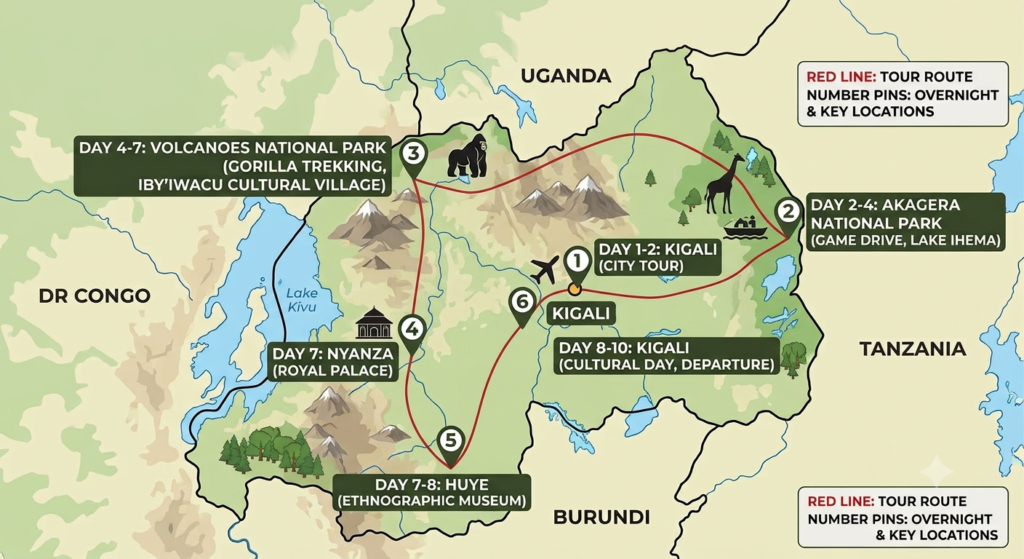
A Sample Day-by-Day Itinerary: 10 Days from Kigali
For travelers who want the fuller Uganda-Rwanda circuit rather than the shorter five-day version, here is what a well-paced 10-day itinerary starting and ending in Kigali typically looks like.
Experience the charm of Uganda Tours Beginning from Kigali during your travel.
Tourists are increasingly opting for Uganda Tours Beginning from Kigali as their adventure of choice.
Day 1 — Arrival in Kigali. Meet your guide, settle into your hotel, and if time allows, take an introductory walk through the city center before an early night ahead of the border crossing the next day.
Day 2 — Cross into Uganda and transfer to Bwindi. An early departure from Kigali, crossing at Cyanika or Katuna depending on your assigned trailhead sector, arriving in Bwindi in the afternoon with time to rest before the trek.
Day 3 — Gorilla trekking in Bwindi. The heart of the trip’s first half: an early park briefing followed by the trek itself, culminating in one unforgettable hour with a habituated mountain gorilla family.
Day 4 — Transfer to Queen Elizabeth National Park via Ishasha. A scenic drive north through the Ishasha sector, keeping watch for Queen Elizabeth’s famous tree-climbing lions, before continuing to the main park area for the night.
Day 5 — Queen Elizabeth game drive and Kazinga Channel cruise. A morning game drive across the park’s open plains in search of lion, elephant, and buffalo, followed by an afternoon boat cruise along the Kazinga Channel, one of the highest-density wildlife waterways in East Africa.
Day 6 — Transfer to Kibale Forest for chimpanzee tracking. A shorter drive north to the Kibale area, positioning travelers for an early trek the following morning.
Day 7 — Chimpanzee tracking in Kibale. An early forest trek in search of habituated chimpanzee communities, part of one of the highest primate concentrations found anywhere in Africa.
Day 8 — Transfer back toward the Rwanda border. A longer travel day retracing the route south, often with a stop at Lake Bunyonyi for a lighter, more relaxed afternoon before the final border crossing.
Day 9 — Cross back into Rwanda and visit Akagera or Volcanoes National Park. Depending on the specific route chosen, either a game drive in Akagera National Park or a shorter visit near Volcanoes National Park, giving travelers a taste of Rwanda’s own wildlife destinations before returning to Kigali.
Travelers prefer Uganda Tours Beginning from Kigali for their unique experiences.
Invite your friends to join you on Uganda Tours Beginning from Kigali for shared adventures.
Day 10 — Return to Kigali and departure. A final transfer back to Kigali, with time for last-minute shopping or a final walk through the city before your onward flight.
This structure spreads the trip’s most physically demanding days, gorilla trekking and chimpanzee tracking, across the middle of the itinerary rather than stacking them together, while using the first and final days for lighter travel and city time, a pacing pattern that consistently produces the best-reviewed longer circuits.
Health, Fitness, and Practical Logistics for the Journey
Beyond the standard health preparations for any Uganda or Rwanda trip, yellow fever vaccination, malaria prophylaxis, and comprehensive travel insurance, a Kigali-starting itinerary carries a few additional practical considerations worth planning around. Because the trip involves several hours of overland driving on both the outbound and return legs, travelers prone to motion sickness should pack accordingly, and those with mobility limitations should discuss vehicle configuration and rest-stop frequency with their operator in advance. Road conditions on the main routes between Kigali and southwestern Uganda have improved substantially in recent years, but rural stretches on both sides of the border can still be uneven, particularly during the rainy season, so building a small buffer into arrival and departure timing is a sensible precaution rather than an overreaction.
Join the many satisfied travelers who loved Uganda Tours Beginning from Kigali.
Fitness requirements for the trip as a whole are shaped primarily by the gorilla trek itself rather than by the driving days, since the trekking terrain in Bwindi and Mgahinga can be genuinely steep and, depending on rainfall, slippery underfoot. Porters are available to hire at every trailhead and are worth engaging both for the practical assistance over difficult terrain and for the direct income they provide to local communities living alongside the parks.
Photography and Scenery Along the Kigali–Uganda Route
One underrated benefit of the overland route between Kigali and southwestern Uganda is the scenery itself, which many travelers describe as a highlight in its own right rather than simply the means of getting from one activity to the next. Rwanda’s side of the journey passes through the country’s famous terraced hillsides, often dotted with tea plantations and small farming communities, while the Uganda side, particularly around Kisoro and the approach to Bwindi, offers dramatic views of the Virunga volcanic range on clear days. Travelers with a camera should keep it accessible during the drive rather than packed away, since some of the most striking images from a Kigali-starting trip come from unplanned stops along this stretch of road rather than from the parks themselves. A wide-angle lens suits the sweeping hillside views particularly well, complementing the longer telephoto lenses more commonly used once travelers reach the forest and savannah destinations further along the itinerary.
Because so many Kigali-starting itineraries include at least one full day in the city, either before departure toward Uganda or after the trip’s return, it is worth treating Kigali as more than a transit point. The Kigali Genocide Memorial offers a sobering but important look at Rwanda’s history and its remarkable process of national reconciliation, and is widely considered essential for any visitor spending time in the city. Mount Kigali offers panoramic views over the city’s famous hills, while the city center’s markets, art galleries, and café culture reward travelers who give themselves even half a day to explore on foot. Kenlink Tours’ one-day Kigali city tour covers a similar range of stops and is a useful reference point for structuring an independent day in the city, whether visited before heading toward Uganda or as a closing day before departure. For a broader sense of what else the wider region offers beyond the capital, Kenlink Tours’ roundup of must-see attractions and activities in Rwanda is a useful companion resource covering everything from gorilla trekking to Lake Kivu and the Congo Nile Trail.
Best Time of Year for a Kigali-Starting Trip
Uganda and Rwanda share a broadly similar climate pattern, with the region’s dry seasons running roughly June through September and December through February. These months bring easier underfoot conditions on forest trails and more predictable weather for the overland drive between Kigali and Uganda’s parks, but they are also peak booking periods, meaning gorilla permits and lodge availability should be secured well in advance. The wetter months, March through May and October through November, bring lusher scenery, thinner crowds, and often better lodge rates, at the cost of muddier trekking conditions. Because gorillas do not migrate and remain within their forest home ranges year-round, trekking itself remains viable throughout the year regardless of season, so travelers with flexible dates should weigh the trade-off between crowd levels and trail conditions rather than assuming any particular month is categorically off-limits.
What to Pack for a Kigali-Starting Uganda Trip
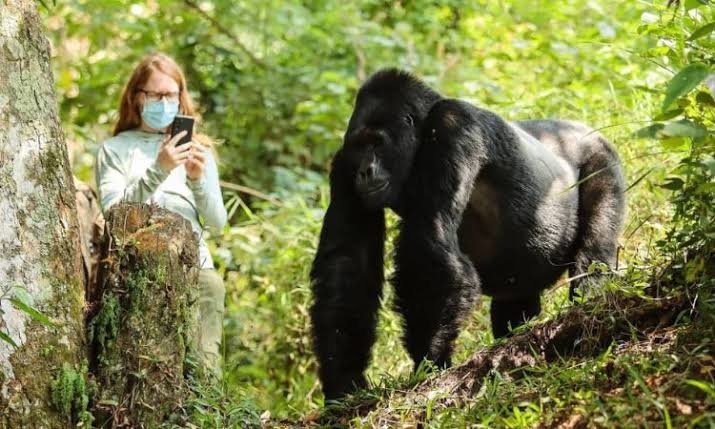
Packing for this kind of trip needs to account for both the forest trekking itself and the overland border crossing. Sturdy, waterproof hiking boots, a rain jacket, and layered clothing in neutral colors remain essential for the trekking days, alongside gardening or trekking gloves for the nettles and thick vegetation common on Bwindi’s and Mgahinga’s trails. For the road journey between Kigali and the parks, comfortable travel clothing, a good book or entertainment for the drive, and snacks for the journey are all worth packing separately from your trekking gear. Travelers should also carry printed or easily accessible digital copies of their passport, visa documentation, and yellow fever vaccination certificate specifically for the border crossing, since these are the documents most commonly requested at Cyanika and Katuna.
Where to Stay: Kigali and the Park Corridor
Kigali itself offers accommodation across every price point, from simple guesthouses to internationally branded hotels, making it an easy city to spend a night or two in comfortably regardless of budget. Near Bwindi, lodges cluster around each of the park’s trailhead sectors, so where you stay often depends on which sector your gorilla permit is assigned to, a detail your operator should confirm well before your arrival date. Because Pick and Transfer Safaris specializes in trips designed for budget and mid-range travelers, our Kigali-starting itineraries default to comfortable, well-reviewed properties that keep the overall cost of the trip reasonable without sacrificing the quality of the experience, though upgrades to higher-end lodges are always available on request.
Budgeting for a Kigali-Starting Trip
Cost considerations for a Kigali-starting trip mirror those of any Uganda gorilla safari, with a few additional line items specific to the cross-border routing. Gorilla permits remain the single largest fixed cost, priced per person per trek by the Uganda Wildlife Authority regardless of which city the trip begins from. Cross-border transport, whether a private vehicle with driver-guide or a shared group vehicle, is generally a modest additional cost relative to what an equivalent Entebbe-based transfer would require, given the shorter driving distance involved. Visa costs vary depending on whether travelers choose separate single-entry visas for each country or the East Africa Tourist Visa, and this choice is worth working out early in the planning process, since it affects both cost and the flexibility of the overall itinerary. Accommodation costs scale with the length of the trip and the property tier chosen, and remain the second-largest expense after permits for most itineraries described in this guide.
Combining Uganda’s Parks with Rwanda’s Own Attractions
One of the clearest advantages of a Kigali-starting itinerary is how naturally it allows travelers to combine Uganda’s parks with Rwanda’s own wildlife destinations on a single trip, rather than treating the two countries as entirely separate journeys. Rwanda’s Volcanoes National Park offers its own mountain gorilla trekking experience, a short drive from Kigali, and pairs naturally with a Uganda-focused itinerary for travelers who want to experience gorilla trekking in both countries. Akagera National Park, in eastern Rwanda, is the country’s own Big Five destination, and our 3 Days Akagera National Park Safari from Kigali offers a standalone way to add savannah game viewing to a Kigali-based trip without crossing into Uganda at all. Nyungwe Forest National Park, one of Africa’s oldest rainforests, adds chimpanzee tracking and a canopy walk experience within Rwanda itself, and our 3 Days Nyungwe Safari and 2 Days Nyungwe Chimps Tracking Trip both build itineraries specifically around this forest. For travelers wanting a broader introduction to Rwanda alongside a city stay, our 4 Days Rwanda Wildlife and City Tour rounds out the country’s highlights within a short window.
Practical Considerations Specific to Cross-Border Travel
A handful of practical details are worth understanding specifically because this kind of trip crosses an international border partway through, something that does not apply to a purely Entebbe-based Uganda trip. Currency matters: Rwanda uses the Rwandan franc while Uganda uses the Ugandan shilling, and most travelers find it easiest to carry a modest amount of US dollars as a backup, since dollars are widely accepted for tourism-related payments in both countries, particularly for permits and larger transactions. Mobile connectivity also changes at the border, so travelers relying on a local SIM card should plan for either a regional data package or picking up a second SIM once across into Uganda. Time zones are aligned between the two countries, so no adjustment is needed there, which at least removes one variable from an otherwise document-heavy crossing process.
Responsible Tourism Along a Kigali-Starting Route
The conservation principles that govern gorilla trekking apply equally regardless of which city a trip begins from. Minimum viewing distances, capped group sizes, and health screening before treks all exist to protect habituated gorilla families from the disease risk that comes with sustained close contact with humans, and following these rules carefully is part of why gorilla populations in this region have grown rather than shrunk in recent decades. The same principle extends to responsible behavior at the border itself and throughout the overland journey: choosing operators and drivers who follow proper documentation procedures, respect local communities along the route, and support conservation-linked tourism initiatives on both sides of the border all compound into a more sustainable travel model over time. At Pick and Transfer Safaris, part of our profits goes toward supporting community and orphan-care projects in the areas where we operate, reflecting a broader commitment to making sure tourism revenue benefits the region long after a trip has ended.
Common Mistakes to Avoid When Planning a Kigali-Starting Trip
Underestimating visa complexity. Because this kind of trip involves at least one border crossing, and sometimes several on longer circuits, visa planning deserves more attention than a single-country trip would require. Confirm your visa approach, whether separate visas or the East Africa Tourist Visa, well before booking flights.
Booking gorilla permits too late. Permit scarcity affects Kigali-starting trips exactly as much as Entebbe-starting ones, since permits are tied to the trekking date and sector, not the traveler’s entry city. Confirm your permit date early and build the rest of the itinerary around it.
Treating Kigali purely as a transit point. Travelers who fly in and out without giving the city any time of its own often regret skipping what is, by most accounts, one of Africa’s most pleasant and walkable capitals. Even a half day makes a meaningful difference.
Skipping travel insurance. Given both the physical nature of gorilla trekking and the cross-border logistics involved, comprehensive travel insurance covering trekking activities, medical evacuation, and multi-country travel is strongly recommended for any itinerary described in this guide.
Choosing an operator unfamiliar with the border crossing. Not every tour operator is equally experienced with cross-border logistics between Rwanda and Uganda. Working with an operator who handles this route regularly, and who can assist with documentation at the crossing itself, meaningfully reduces the friction of the journey.
Frequently Asked Questions
Is it really faster to reach Bwindi from Kigali than from Entebbe? Yes. The drive from Kigali to Bwindi typically takes three to four hours, compared with nine to eleven hours from Entebbe, making Kigali the significantly faster starting point for gorilla trekking specifically.
Do I need a separate visa for Rwanda and Uganda? Not necessarily. The East Africa Tourist Visa allows multiple entries across Rwanda, Uganda, and Kenya on a single visa, which is often more convenient than obtaining separate single-entry visas for each country, particularly for itineraries that cross the border more than once.
Can I do a one-day gorilla trek starting from Kigali? Yes, though it requires a genuinely early start and a long day overall. Our One-Day Uganda Gorilla Safari Starting from Kigali is built specifically for travelers who need to complete the experience within a single day.
Which border crossing should I use, Cyanika or Katuna? This depends on your destination. Cyanika suits travelers heading to Mgahinga Gorilla National Park or the Kisoro area, while Katuna is the more common route for travelers heading to Bwindi’s Ruhija or Buhoma sectors, or continuing north toward Queen Elizabeth National Park.
Should I fly into Kigali or Entebbe if I want to see all of Uganda’s parks? For itineraries centered heavily on gorilla trekking and southwestern Uganda, Kigali is the more efficient starting point. For itineraries centered more on Uganda’s Big Five circuit and northern parks like Murchison Falls, Entebbe remains more convenient, and many longer itineraries fly into one city and out of the other to capture the best of both.
Can this trip be combined with Kenya, Tanzania, or Burundi? Yes. Longer circuits such as our 18 Days Kenya Rwanda Uganda Safari and 20 Days Uganda Rwanda Burundi Combo Safari both use Kigali as a natural anchor point for extending a gorilla-focused trip into a wider regional circuit.
Is Kigali itself worth visiting, or should I head straight to Uganda? Kigali is genuinely worth even a half day of your time, particularly the Kigali Genocide Memorial and the views from Mount Kigali. Most travelers on longer itineraries build in at least one night in the city on either end of the trip.
Group Travel Versus Private Departures

Travelers planning a Kigali-starting trip generally choose between two broad formats, and understanding the trade-offs helps in selecting the right one. A private departure, with a dedicated vehicle and driver-guide for just your own party, offers maximum flexibility: departure times, rest-stop frequency, and even minor itinerary adjustments can all be tailored to your preferences, and this format is especially valuable for the cross-border driving days, where a private vehicle can move at whatever pace suits the group rather than accommodating a wider mix of travelers. The trade-off is cost, since a private vehicle and guide are priced per group rather than split across a larger number of travelers.
Joining a scheduled group departure, by contrast, spreads the cost of the vehicle and guide across several travelers, which can meaningfully reduce the per-person price, particularly for solo travelers or couples. The trade-off here is less flexibility around timing and pacing, since the itinerary needs to accommodate the group as a whole. For most travelers on a Kigali-starting gorilla trekking trip, the decision often comes down to budget versus flexibility, and it is worth discussing both options directly with your operator before booking, since availability for group departures on specific gorilla trekking dates can be more limited than for a private, fully customized itinerary.
Choosing the Right Operator for a Cross-Border Trip
Not every tour operator handling Uganda safaris is equally well set up to manage a Kigali-starting, cross-border itinerary specifically. A few questions are worth asking before committing to an operator for this kind of trip. Does the operator’s vehicle and driver-guide cross the border with you, or does the trip involve a handoff between separate teams on each side? A continuous journey with the same driver-guide throughout tends to produce a smoother, more coherent experience than a handoff partway through, particularly for shorter itineraries where efficiency matters most. Does the operator have direct, current experience with both the Cyanika and Katuna crossings, and can they advise on which is more appropriate for your specific park destination? Operators who run this route regularly will have up-to-date knowledge of border wait times, seasonal road conditions, and any recent changes to documentation requirements, which is difficult to replicate from a purely Entebbe-based operation.
It is also worth asking how an operator handles gorilla permit booking specifically for Kigali-starting itineraries, since permits must still be booked through Uganda Wildlife Authority regardless of the traveler’s entry point, and coordinating permit dates against a cross-border itinerary requires slightly more advance planning than a straightforward Entebbe-based trip.
Currency, Connectivity, and Communication on the Road
A few smaller but genuinely useful practical details round out the planning picture for a Kigali-starting trip. Rwanda’s currency is the Rwandan franc and Uganda’s is the Ugandan shilling, and while both currencies are used in their respective countries, most tour operators, lodges, and permit offices across the region accept US dollars for tourism-related payments, making a modest cash reserve in dollars a sensible backup regardless of which local currency you also carry. Card payment infrastructure has expanded considerably in both countries’ urban centers, particularly Kigali, but remains inconsistent in more rural areas near the parks, so relying on cash for smaller purchases along the route remains the safer approach.
Mobile connectivity is generally reliable in Kigali and along the main road corridors, though it becomes patchier once inside the forested sections of Bwindi and Mgahinga themselves, which for many travelers is a welcome, if temporary, disconnection from constant connectivity. Travelers relying on a local SIM card for data should plan for either a regional data package that works across both countries, where available, or picking up a second local SIM once crossing into Uganda, since Rwandan and Ugandan mobile networks operate separately. Keeping your accommodation and guide’s contact details saved offline, rather than relying solely on an internet connection, is a simple but worthwhile precaution for the more remote stretches of the journey.
Family Travel and Traveling with Children
Families considering a Kigali-starting Uganda trip should be aware of a few specific considerations. Uganda Wildlife Authority sets a minimum age of 15 for gorilla trekking itself, largely to protect the gorillas’ own health, since young children are statistically more likely to be carrying common colds or other mild illnesses that could pose a risk to a habituated gorilla family. This age restriction applies regardless of whether the trip starts from Kigali or Entebbe. Families traveling with younger children can still enjoy much of the rest of a Kigali-starting itinerary, including Kigali’s own city attractions, a game drive in Akagera or Queen Elizabeth National Park, where no comparable age restriction applies, and Rwanda’s cultural and community-based experiences, while arranging a separate, supervised activity or a shorter itinerary adjustment for the specific trekking days themselves. Discussing your family’s composition and ages directly with your operator during planning allows for a itinerary that includes everyone meaningfully rather than requiring part of the group to simply wait behind during the trek.
Solo Travelers and Kigali-Starting Trips
Kigali’s status as a genuinely safe, walkable capital city makes it a particularly comfortable starting point for solo travelers, many of whom appreciate the chance to spend a day or two exploring the city independently before joining a guided itinerary for the trekking portion of the trip. Solo travelers on a budget should specifically ask about group departure options, discussed earlier in this guide, since joining a scheduled group can substantially reduce per-person costs compared with a fully private itinerary, while still providing the safety and structure of an organized tour for the cross-border driving and trekking days. For solo travelers who do prefer a private itinerary, the flexibility to set your own pace, particularly valuable on the longer, multi-day circuits described earlier in this guide, is often cited as one of the strongest arguments in favor of the additional cost.
Why More Travelers Are Choosing Kigali Every Year
The steady shift toward Kigali as a starting point for Uganda tourism is not simply a matter of driving distance, though that remains the single biggest factor. Kigali’s own growth as a travel destination in its own right, its reputation for safety and cleanliness, its expanding direct flight network, and the simple convenience of the East Africa Tourist Visa have all combined to make it an increasingly natural choice, even for travelers whose primary interest is Uganda’s gorillas rather than Rwanda itself. For tour operators across the region, this shift has meant building genuinely dedicated Kigali-starting itineraries, rather than treating Kigali as an afterthought bolted onto Entebbe-based routes designed for a different kind of traveler. That is precisely the approach we have taken at Pick and Transfer Safaris, and it is a trend we expect to continue as more travelers discover just how much time, and how much unnecessary driving, a Kigali start can save.
A Final Pre-Departure Checklist
Before setting off on a Kigali-starting Uganda trip, a short checklist helps ensure nothing important slips through the planning process. Confirm your gorilla trekking date and permit well in advance, since this single detail anchors the timing of the entire rest of the itinerary. Verify your visa arrangement, whether separate visas for Rwanda and Uganda or the East Africa Tourist Visa, and apply early enough to avoid any last-minute complications. Carry your yellow fever vaccination certificate alongside your passport and visa documentation, since this is commonly requested at both the airport and the land border crossing. Pack separately for the trekking days and the driving days, since the gear each requires is genuinely different, and confirm with your operator which lodges or hotels are included on which nights so you know what to expect regarding amenities like hot water, WiFi, and electricity access, particularly at more remote properties near the parks. Finally, build a small buffer of unscheduled time into your itinerary where possible, particularly around the border crossing and any long driving days, since East Africa’s roads, while considerably improved in recent years, can still occasionally involve delays that a fully back-to-back schedule leaves no room to absorb.
How Weather Can Shift Your Experience
Even within the broad dry-season and wet-season pattern described earlier, day-to-day weather along a Kigali-starting route can vary meaningfully by elevation and location. Kigali itself sits at a relatively high elevation and enjoys a mild, spring-like climate for most of the year, rarely reaching the extremes of heat found in Uganda’s lower-lying savannah parks. As the route climbs into the volcanic highlands around Bwindi and Mgahinga, temperatures cool further, and mornings can be genuinely chilly, particularly before sunrise on trekking days, making a warm layer worth packing even during the driest months. Once the itinerary descends toward Queen Elizabeth National Park or Kibale Forest, conditions warm again, closer to what most travelers picture as classic equatorial African weather. Understanding this elevation-driven variation helps travelers pack more precisely than a single generic Uganda packing list would suggest, since a jacket that feels essential on a misty Bwindi morning would be entirely unnecessary a few hours later on a Queen Elizabeth game drive.
The Growing Popularity of Multi-Country East African Itineraries
The broader trend behind Kigali’s rise as a starting point reflects a wider shift in how international travelers approach East Africa as a whole. Rather than choosing a single country and building an itinerary entirely within its borders, a growing share of travelers now think in terms of the region as a connected whole, moving fluidly between Rwanda, Uganda, and increasingly Kenya, Tanzania, and Burundi within a single trip. This shift has been driven by improving road infrastructure, the East Africa Tourist Visa’s multi-country convenience, and a simple recognition among travelers that the region’s highlights, gorillas, chimpanzees, Big Five wildlife, and Rift Valley scenery, do not respect national borders even though most trip planning historically has. Kigali’s central geographic position within this regional network is precisely what makes it such a natural hub for this kind of thinking, and it is a large part of why so many of the itineraries described throughout this guide are built around multi-country routing rather than a single-country focus.
Customizing Your Own Kigali-Starting Itinerary
Every itinerary described in this guide represents a starting template rather than a fixed script, and one of the genuine advantages of working with an operator based in the region is the ability to adjust these templates around your specific dates, interests, and pace. Travelers who want extra time in Kigali before heading toward the border, an additional rest day built into a longer circuit, or a different balance between gorilla trekking, chimpanzee tracking, and Big Five game viewing than a standard template offers can typically have these adjustments accommodated without much difficulty, provided the request is made early enough in the planning process for permit and lodge availability to be confirmed accordingly. This flexibility is part of what makes Kigali such a strong hub for trip planning in the first place: the short distances involved between the city, the border, and Uganda’s southwestern parks give a well-organized itinerary considerably more room to flex around a traveler’s specific preferences than a route built around Uganda’s more spread-out geography from Entebbe alone would allow.
Conclusion
Kigali has genuinely changed how travelers plan Uganda gorilla trekking, turning what used to require a demanding multi-day overland journey from Entebbe into a fast, efficient route straight into Bwindi or Mgahinga. Whether you have a single intense day to spare or a full month to explore Uganda, Rwanda, and beyond, there is a Kigali-starting itinerary built around your available time, from our shortest gorilla safaris all the way through our longest extended safaris covering multiple countries. Learn more about who we are or get in touch with our team to talk through your travel dates, gorilla permit availability, and which of these Kigali-based routes fits your trip best.