- LET'S PLAN YOUR SAFARI
- +256 200 921 002
- +256 793 194 703
- info@pickandtransfersafaris.com

Visiting the top of Murchison Falls
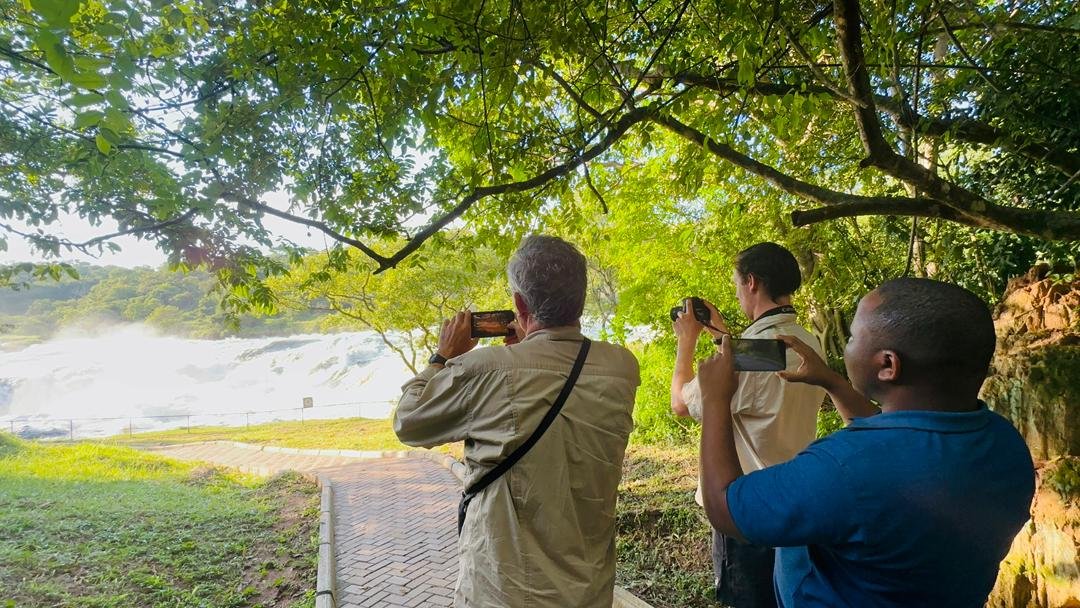
Visiting the top of Murchison Falls. There are places in the natural world that stop you completely — not with their size or their colour, but with their sheer, undeniable power. The top of Murchison Falls is one of those places. Standing at the edge of the gorge where the entire volume of the River Nile, the world’s longest river, forces itself through a gap just seven metres wide before plunging 43 metres into the churning pool below — known as the Devil’s Cauldron — is an experience that operates on every sense at once. The ground trembles beneath your boots. The roar surrounds you so completely that conversation becomes impossible. The spray rises in a permanent mist, catching the light into rainbows. And directly below you, the most powerful waterfall in the world is doing what it has done, without pause, for thousands of years.
Visiting the top of Murchison Falls is considered one of the most memorable activities in Murchison Falls National Park — and given the competition from game drives, Nile boat cruises, chimpanzee trekking, and birding, that is saying something significant. At Pick and Transfer Safaris, we build the top of the falls hike into our Murchison itineraries as a non-negotiable highlight, and we are always happy to help travellers plan the best way to combine it with the park’s other extraordinary experiences. For itinerary planning and booking inquiries, email our team at info@pickandtransfersafaris.com and we will get back to you quickly.
The Falls Themselves: Why This Waterfall Is Different
Murchison Falls was named in 1864 by the British explorer Sir Samuel Baker, who stood on a rock at the base and named the falls after Sir Roderick Murchison, president of the Royal Geographical Society. Winston Churchill passed through the same area in 1907, trekking a path that hikers still follow today, and later described Uganda as the Pearl of Africa — a description that has endured. The falls are also known locally as Kabalega Falls, named after a Bunyoro king who defended this region against British colonization in the late nineteenth century.
What makes Murchison Falls physically extraordinary is the combination of volume and confinement. The Nile at this point carries an enormous amount of water — the outflow of Lake Victoria, the world’s largest tropical lake — and all of that water is compressed into a gorge barely wide enough for a single-lane road. The resulting force creates a waterfall that has been described as the most powerful in the world. The noise alone communicates that power before the falls come into view: a deep, continuous roar that grows steadily as you approach the top, building until it fills the air entirely and you feel it as much as hear it. At the very edge, where the water leaves the gorge and drops into the Devil’s Cauldron below, the sight is simultaneously terrifying and exhilarating.
On certain days — particularly during the wet season when the Nile runs highest — a secondary waterfall called Uhuru Falls becomes visible just downstream from the main falls. Uhuru Falls, whose name means “freedom” in Swahili, formed in 1962 when the Nile flooded and split at that point. Seeing both falls simultaneously during a high-water visit adds a further layer to the experience and gives a deeper understanding of the Nile’s immense power across the landscape.
How to Get to the Top: Baker’s Point and the Trail
The top of the falls is most commonly reached by combining the upstream Nile boat cruise with the hike, which is the sequence most visitors and guides recommend. The boat departs from the Paraa docks and travels upstream along the Victoria Nile for approximately three hours, past hippos, crocodiles, elephants, and extraordinary birdlife, before reaching Baker’s Point — named after Sir Samuel Baker himself, who stood on the large rock at this spot when he documented the falls. This is where hikers disembark and meet their Uganda Wildlife Authority ranger guide for the hike.
The hike to the top of the falls from Baker’s Point covers approximately five kilometres and takes between 45 minutes and one and a half hours depending on pace, fitness, and the time spent pausing at the viewpoints along the trail. The Uganda Wildlife Authority has set up multiple resting points along the trail, and the path is well maintained with paved sections and marked steps — though some sections near the falls are steep and can be slippery due to the perpetual mist rising from the gorge below. The trail is described as moderately challenging rather than extreme: it does not require technical hiking skills or exceptional fitness, but a reasonable level of physical condition is recommended for comfort.
The trail begins at river level and climbs through rocky terrain and lush green vegetation alongside the Nile, with the sound of the falls growing louder with every step of the ascent. As you move higher, views of the river open up below you — swirling rapids, the dense forest on the opposite bank, the occasional flash of a kingfisher across the water. Rainbows appear in the mist at various points along the trail, sometimes multiple at once, arcing against the green and grey of the gorge walls. The Uganda Wildlife Authority ranger who accompanies your group provides insight into the geology, history, and vegetation of the falls throughout the hike, answering questions and pointing out wildlife along the route.
At the summit, the experience is complete. You stand above the gorge and watch the Nile gather itself into an impossible rush before disappearing through the narrow gap at your feet. The view back downstream — the river broadening after the fall into a wide, calm expanse, the savannah plains stretching to the horizon, the sky enormous and equatorial — is one of the finest panoramas anywhere in Uganda. Information boards at the top detail the geological history of the falls and the Albertine Rift Valley that frames them. Most visitors spend between 30 minutes and an hour at the summit, reluctant to leave.
The falls can also be reached by road if you prefer not to combine the hike with the boat cruise. Vehicles access the top of the falls directly from the northern bank road network, following park tracks to the gorge rim. This option is quicker and accessible to visitors who are less mobile or who prefer a shorter visit, though the boat cruise approach is universally considered the more dramatic and rewarding sequence.
What to Expect on the Trail
The hike is suitable for most adult travellers with average fitness. Sturdy footwear with good grip is the most important item to bring — the trail includes uneven steps and sections of wet, mist-damp rock near the top. Long trousers and a long-sleeved shirt are comfortable for the walk, and a lightweight rain jacket or poncho is recommended near the summit, where the mist from the falls is persistent enough to leave you noticeably damp. Bring sunscreen, a hat, and insect repellent for the sections of the trail away from the falls, where the equatorial sun can be intense.
A camera is essential — the falls at the top offer some of the most dramatic photographs you will take anywhere in Uganda, and the views from the ascent are equally compelling. A small daypack carrying water, a light snack, and your camera gear is all you need. The hike cost is approximately $20 per person for foreign non-residents, paid to the Uganda Wildlife Authority at the park.
Wildlife along the trail is secondary to the falls experience but not absent. Black-and-white colobus monkeys are occasionally seen in the forested sections, and the birdlife around the river and gorge walls includes African fish eagles, kingfishers, cormorants, goliath herons, and a variety of sunbirds. Keep your eyes open particularly during the boat cruise portion of the journey, where wildlife sightings are almost guaranteed.
Combining the Top of the Falls with Other Murchison Activities
The top of the falls hike is best understood as one part of a well-rounded Murchison Falls itinerary rather than a standalone activity. The classic combination is an upstream boat cruise in the morning followed by the hike at Baker’s Point — together they give you the falls from two perspectives, at water level and from above, and the boat provides outstanding wildlife viewing that the trail itself does not replicate. An afternoon game drive on the northern bank savannah adds the big game experience — lions, elephants, Rothschild’s giraffes, buffaloes — to complete a near-perfect Murchison day.
For travellers with more time, chimpanzee trekking in Budongo Forest, the downstream Nile Delta cruise for shoebill stork sightings, night game drives, and sport fishing on the Nile each add a distinct dimension to the park experience. Murchison rewards multiple days, and most travellers who budget two or three nights in the park leave wishing they had scheduled more.
Plan Your Murchison Falls Visit with Pick and Transfer Safaris
At Pick and Transfer Safaris, we design Murchison Falls itineraries that make the most of every day in the park, combining the top of the falls hike, boat cruises, game drives, and any other activities that suit your schedule and interests. Murchison pairs naturally with gorilla trekking in Bwindi Impenetrable Forest National Park or chimpanzee trekking in Kibale Forest for a complete Uganda wildlife safari. Our 10 Days Uganda Rwanda Safari is our most comprehensive itinerary, weaving Murchison together with gorilla trekking and Rwanda highlights into a single seamless journey.
Browse our Uganda Safaris page for the full range of options, and reach out to us at info@pickandtransfersafaris.com or our Contact Us page with your travel dates and group size. A portion of every booking we take supports community development through the Kigezi Foundation, so your journey through Uganda contributes to something lasting.
Standing at the top of Murchison Falls, with the Nile thundering through the gorge at your feet and rainbows forming in the mist around you, is one of those moments that stays with a person long after everything else has blurred. It belongs on every Uganda safari itinerary without exception.