- LET'S PLAN YOUR SAFARI
- +256 200 921 002
- +256 793 194 703
- info@pickandtransfersafaris.com

What Happens During the Gorilla Habituation Experience?
What Happens During the Gorilla Habituation Experience? Booking the Gorilla Habituation Experience is straightforward enough, secure a permit, arrange a lodge, show up in Rushaga. What actually happens once you’re there is less commonly explained in detail. At Pick and Transfer Safaris, we like travelers to know exactly what to expect before they commit, since this genuinely shapes how prepared and comfortable the day feels. This guide walks through the experience step by step, from the early morning wake-up call to the return trek at the end of a long day.
Before Dawn: Getting to the Park Headquarters
The day begins earlier than standard gorilla trekking, with most lodges arranging a wake-up call around 5:30 to 6:00 AM to allow time for breakfast and the drive to Rushaga’s park headquarters. Given how physically demanding the day ahead is, a proper breakfast matters more here than it might on a shorter activity, and most lodges prepare something substantial rather than a light continental spread. Many also pack a lunch and extra water for the trek itself, since you won’t be returning to the lodge until well into the afternoon or evening.
The Briefing
Arrival at park headquarters is typically expected by 7:00 to 7:30 AM, roughly half an hour earlier than the standard trekking briefing given the more involved nature of the day ahead. Here you’ll meet the full team accompanying your group: a senior tracker, researchers working with the specific semi-habituated family, and armed ranger guides. The briefing covers safety protocols, the minimum distancing rule, currently enforced at 10 meters in many cases, mask requirements, and behavioral expectations, along with a health check where rangers assess whether any member of the group is showing symptoms of illness that would prevent participation.
Because only four visitors join each Gorilla Habituation Experience group, this briefing tends to feel considerably more personal and conversational than the standard trekking equivalent, where up to eight strangers might be assigned to a single group. Take the opportunity here to ask questions about the specific family you’ll be visiting and where they were last located, since your team often has genuinely useful context to share before you set out.
The Trek to Find the Family
Trackers typically head into the forest ahead of the main group at dawn to locate the family’s approximate position, based on where they nested the previous night and any fresh signs along the way. Once your group sets out, the approach trek itself can take anywhere from one to five hours depending on how far the gorillas have moved, a genuinely wide range that makes this the least predictable part of the entire day. Rushaga’s terrain is steep and often muddy, particularly during the rainy season, and this stretch of the day is where most of the physical demand comes from.
Along the way, your guide will typically point out other forest life, primates, birds, and plant life, since the walk itself passes through genuinely rich habitat even before reaching the gorillas.
Locating the Family and the First Approach
Once trackers signal that the family has been found, the approach slows considerably. Your team moves calmly and deliberately toward the gorillas, maintaining a respectful, non-threatening pace, since a still-acclimating family responds better to a measured approach than a rushed one. This is often described by travelers as one of the more tense, quietly thrilling moments of the day, the anticipation building as the forest opens up and the family comes into view.
The Four Hours
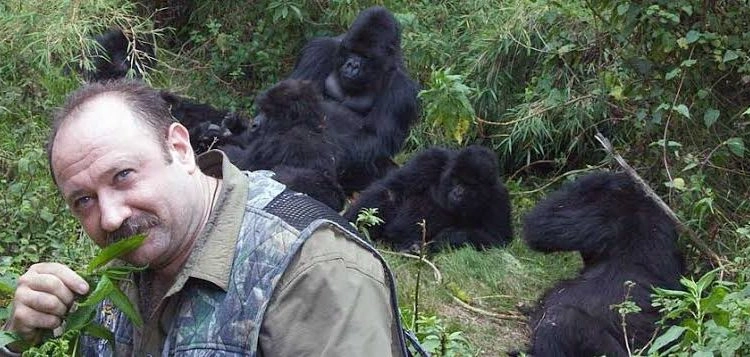
Once you’re positioned at the required distance, your four-hour window with the family begins, and this is where the Gorilla Habituation Experience genuinely diverges from standard trekking. Rather than a single fixed observation period, this time is spent moving with the family as they go about their day, feeding, resting, grooming, and interacting, while researchers continue their ongoing monitoring and habituation work alongside you. Your team will often narrate what’s happening in real time: identifying individual gorillas, explaining family dynamics, and providing context on where this particular group sits in its overall habituation timeline.
Because the family is only semi-habituated, behavior can feel less settled than a standard trek with a fully established group, sometimes involving genuine displays of wariness or caution from individual members, particularly the dominant silverback, as they continue adjusting to sustained human presence. Your rangers and trackers are experienced in reading these cues and will adjust distance or positioning as needed throughout the four hours. Photography is a significant part of this time for many visitors, and the extended window allows for considerably more considered, patient shots than the rushed pace of a standard one-hour visit.
A Working Encounter, Not Just an Observation
One of the more distinctive aspects of this time is that you’re not simply watching from the sidelines. Because researchers are actively conducting habituation work during your visit, participants often describe feeling genuinely involved in an ongoing conservation process rather than positioned purely as spectators. This might mean witnessing specific habituation techniques in action, hearing real-time explanations of how the team is building trust with a particular individual, or simply absorbing a level of detail about gorilla behavior that a standard hour-long trek doesn’t allow time for.
The Return Trek
Once the four hours conclude, the group begins the return trek back to the trailhead, generally following a similar route and taking roughly as long as the approach did, sometimes longer if fatigue has set in by this point in the day. This is typically the quietest stretch of the day, both because conversation naturally winds down after a demanding few hours and because many visitors are processing what they just experienced. By the time you’re back at the trailhead, a full Gorilla Habituation Experience day has typically run eight to ten hours from the initial briefing.
Arriving Back at the Lodge
Given how long and physically demanding the day has been, most travelers arrive back at their lodge in the late afternoon or early evening, ready for little more than a warm shower, dinner, and rest. This is why we generally recommend building a 3-day itinerary around the experience, with nothing scheduled for the following morning, since recovery genuinely matters after a day this demanding.
What Makes This Different From What You Might Expect
Many first-time travelers underestimate how much of the day is spent in transit relative to actual gorilla observation. It’s easy to focus on the headline “four hours with gorillas” and picture a leisurely, extended visit, when in practice the approach and return treks alone can consume as much time as the observation window itself. Understanding this beforehand, rather than being surprised by it on the day, tends to make for a considerably better-prepared and more satisfying experience overall.
Visa and Border Requirements
Since most travelers reach Rushaga via Rwanda, the East African Tourist Visa tends to be the most convenient option, covering multiple entries across Uganda, Rwanda, and Kenya over 90 days for 100 US dollars through Uganda’s official immigration portal. A standard single-entry Uganda Tourist Visa works just as well for travelers not planning to re-enter Rwanda. A valid yellow fever vaccination certificate is required for entry into Uganda regardless of visa type.
Planning Your Gorilla Habituation Experience with Pick and Transfer Safaris
Knowing exactly what the day involves, from the early briefing through the long approach, the four hours themselves, and the return trek, helps travelers arrive genuinely prepared rather than caught off guard by how full the day actually is. If you would like help confirming your Gorilla Habituation Experience permit, arranging a lodge suited to the early start and late return, or planning your private transfer from Kigali, get in touch through our Contact Us page. We’ll make sure you know exactly what to expect before you set foot in Rushaga’s forest.